1921 -1970: World renowned missionary Dr. E. Stanley Jones at Maramon Convention (See Rare Photos)
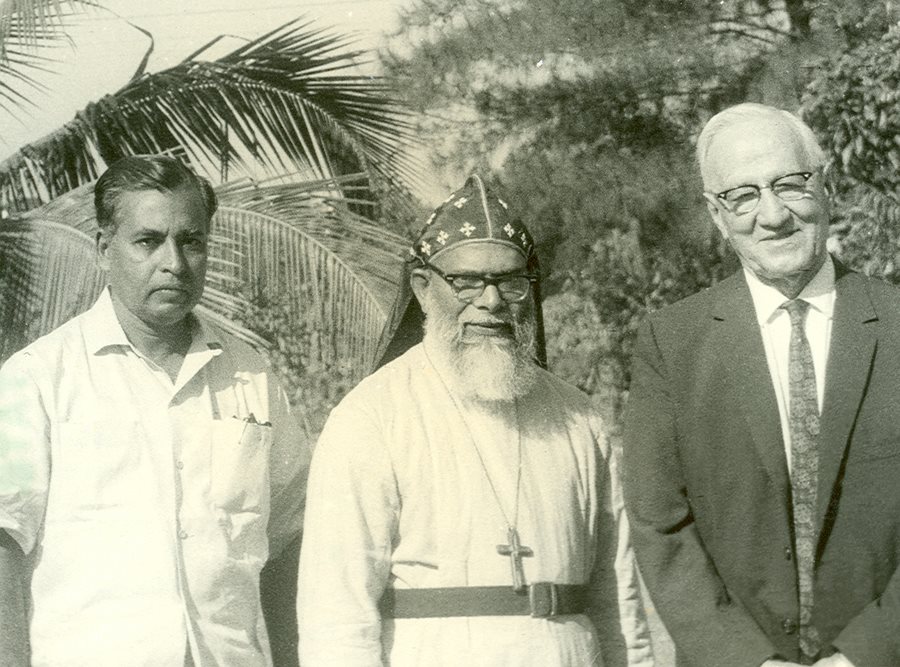
E.Stanley Jones (right) with Alexander Mar Thoma Metropolitan (middle) with an unidentified friend at Sat Tal Ashram, India. (Photos from E. Stanley Jones FB page)
Dr. Eli Stanley Jones was born in Baltimore, Maryland, USA on 3rd January 1884. He was a faculty member at Asbury College, Kentucky, USA when he was called to missionary service in India in 1907 under the Board of Missions of the Methodist Episcopal Church.
He was one of the main speakers of the Maramon Convention from 1921-1970. His messages combined evangelistic challenges with social concerns. The Maramon Convention is one of the largest Christian convention in Asia, and is held at Maramon, Pathanamthitta, Kerala, India annually in February. The venue is on the vast sand-bed of the Pampa River next to the Kozhencherry Bridge. It is organised by Mar Thoma Evangelistic Association, the missionary wing of the Malankara Mar Thoma Syrian Church. The 124th Maramon Convention is happening in 2019.
“For more than half a century Dr E. Stanley Jones proclaimed the Gospel of Christ and applied it to people’s personal, social, national, and international problems. He moved among statesmen and among leaders without portfolios as counselor, friend and worker for peace and goodwill.
Dr Jones became a friend of Mahatma Gandhi and wrote an appreciative biography of Gandhi. In 1950, Dr. Jones provided funds for India’s first Christian psychiatric center, and clinic currently known as Nur Manzil Psychiatric Center and Medical Unit at Lucknow, Uttar Pradesh, India.
~ http://www.facebook.com/SattalAshram”
In 1946, with the help of friends in USA, he donated the first loud speaker setup to the Maramon Convention. He is also the founder of the Sat Tal Christian Ashram movement, Nainital, Uttarakhand, India. He died on January 25, 1973 in his beloved India.
In the 1920s, India began to develop greater appreciation for its own history and culture and greater pride in its own unique contributions to world civilization. Stanley Jones was one of the very first to realize the possibilities that this change in India’s intellectual and spiritual culture created for Christianity and especially for Western Christian missionaries. But he could not fully understand the astounding scope and depth of the possibilities without experiencing the history and culture of his adopted country for himself. So, what better way to immerse himself in the ethos of India than to visit Indian ashrams?
This is exactly what he did. In 1923, he spent two months at Santiniketan, the ashram of the world-famous poet, Rabindranath Tagore. Three years later in 1926 he visited Gandhi’s ashram at Sabarmati.
It is no exaggeration to say that Jones’ visits to these ashrams changed the course of his life. In fact, in 1930, he established his own ashram as a spiritual retreat for Christians modeled on his experience with Ashrams in India. But this was only the first of hundreds of Christian ashrams that would eventually be established throughout the world. These ashrams are truly the work of the Holy Spirit as they continue to inspire, refresh, and renew thousands of Christians in many nations today.
~ From “Ordinary Man, Extraordinary Mission: The Life and Work of E. Stanley Jones” by Stephen A. Graham
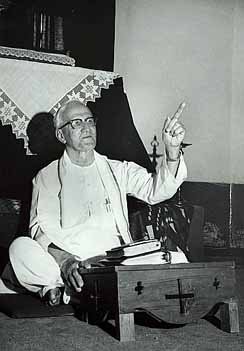
Rev. E. Stanley Jones giving one of his sermons at Sat Tal Ashram, India. (Photo from E. Stanley Jones FB Page)

Bishop T. S. Joseph speaking at the Maramon Convention while Bishop Alexander Mar Theophilus (Metropolitan Alexander Mar Thoma), E. Stanley Jones and Mr. Ramenpillar listen. (Photo from E. Stanley Jones FB page)
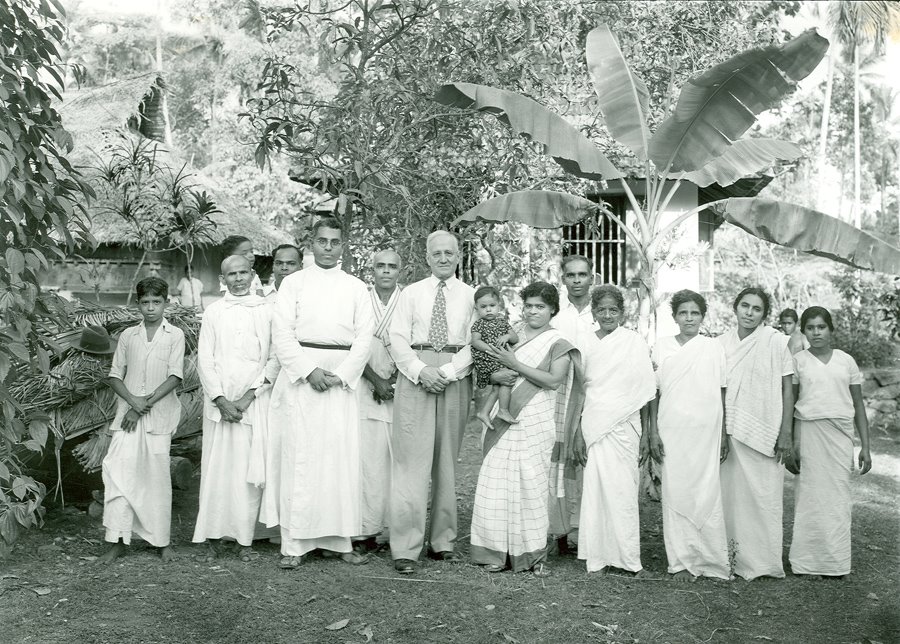
Rev. Stanley Jones with Mar Thoma Church members in Kerala, India. (Photo from E. Stanley Jones FB page)
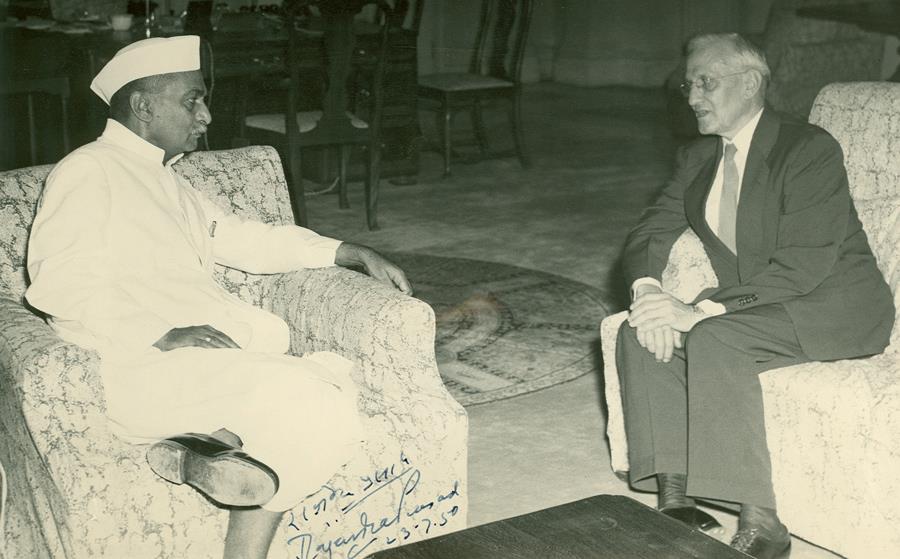
Dr. Stanley Jones with Dr. Rajendra Prasad, first President of India 1950 (Photo from E. Stanley Jones FB page)
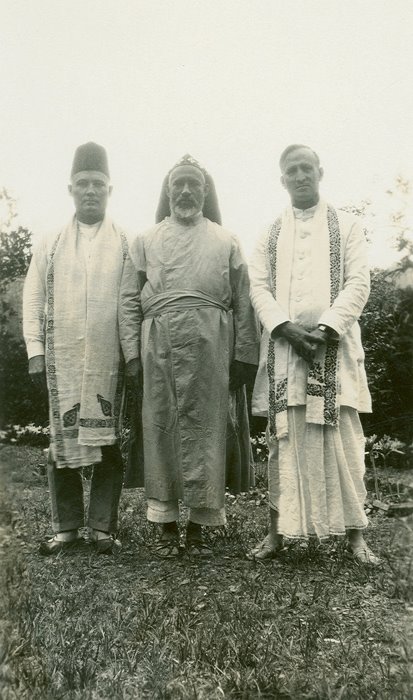
E. Stanley Jones (right) at the Maramon Convention with Bishop Abraham Mar Thoma Metropolitan (middle) and an unidentified friend. (Photo from E. Stanley Jones FB page)

World Sunday School Day: 1st November 2015 (Free Ebook – Robert Raikes and how we got Sunday School)
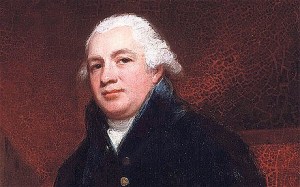
George Romney’s portrait of Robert Raikes, the newspaperman who popularised schooling on Sundays Photo: National Portrait Gallery, London
1st November 2015 : World Sunday School Day – The first Sunday of the Month of November is celebrated throughout the world as Sunday School Day. The Mar Thoma/ CSI/ CNI churches are celebrating Sunday, 1st November, 2015 as World Sunday School Day.
Robert Raikes (1735- 1811), an English Publisher, started the first Sunday School in the city of Gloucester in England in 1780. During the early days, reading, arithmetic and Bible was taught at the Sunday Schools.
In 1809, Church representatives of the Malankara Churches held a meeting at Kandanadu Church, near Ernakualam to arrange facilities to teach children in the Church about religion, prayers and sacraments. The India Sunday School Union was founded in 1876.The Mar Thoma Sunday School Samajam was established on 25 February 1905, at the Maramon Convention.
We encourage our readers to read and share this Free 4 page PDF Ebook Resource for your Sunday Schools and children’s services: Robert Raikes and How We Got Sunday School
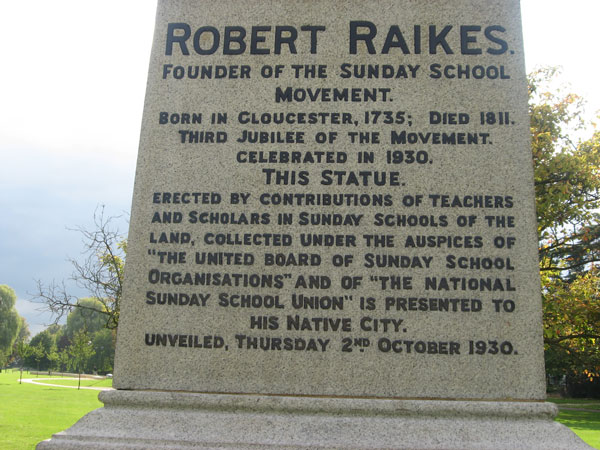
Inscription on the tomb of Robert Raikes.
February, 1917: Sadhu Sunder Singh preaches at Maramon Convention
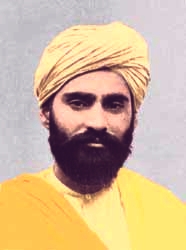
Sadhu Sundar Singh
Sadhu Sunder Singh (3 September 1889-1929) the renowned Indian Christian missionary was one of the speakers of the Maramon Convention in 1918. He spoke in Hindi and the translation was done by Mr. M. O. Oommen, Chief Conservator of Travancore.
Sadhu Sunder Singh drew crowds greater than any previous conventions, so much so that before the end of the week the pandal (covered area) had to be enlarged. It is estimated at the final meeting about 32,000 people gathered to hear his message.

First Sunday of December – Bible Sunday
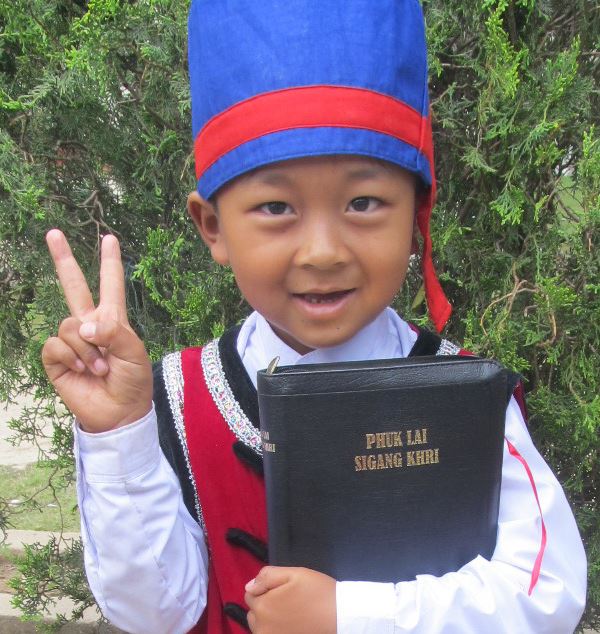
A Myanmar child holding the Bible.
The First Sunday of December is observed as Bible Society Day. It was the British and Foreign Bible Society, established in London in 1804, that first made a concerted effort of translating, printing and publishing Bibles in different languages.
In India, it’s auxiliaries were formed in Calcutta (1811), Bombay (1812), Madras (1820) and in Kerala (1956). Other auxiliaries were formed later. Even before the formation of the auxiliaries in India, the work of translation of the Bible to Indian languages had been taken up by William Carey and his associates in Calcutta. In obedience to the commandment of the Lord “Go ye unto the uttermost corners of the earth and preach my gospel”, the Bible Society aims at making available, copies of the Bible, New Testaments and portions of the Bible to
1.To Every Person in his/her own language.
2.At a price within his/her reach
3.In a style which is easily understood
It is in pursuance of this objective that it brings out special editions for students,members of the armed forces, in Braille type for the blind, etc. The United Bible Society distributes an average of 32 million full Bibles each year. In addition to that, they distribute enough New Testaments and Scripture portions to potentially reach 5% of the world’s population each year. In 2012 they distributed over 405 million Scripture items.
They also manage a growing social media ministry on Facebook and other social networks. The Digital Bible Facebook page reaches millions of young adults every year. 71% report it helps them apply the Bible’s teaching to their lives. https://www.facebook.com/UnitedBibleSocieties

Pages from History: 30th Nov 1945 – Sadhu Kochukunju Upadesi passes away.
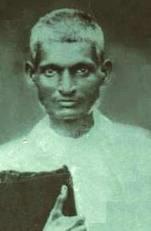
Sadhu Kochu Kunju Upadesi
30th November, 1945 (1121 Virchikam 15): Sadhu Kochukunju Upadesi (b.Dec.1883) passes away. Sadhu Kochukunju Upadesi (Mr. Moothampakkal Itty Varghese,Moothampakkal, Edayaranmula near Chengannur) was a unique personality in history of the Mar Thoma Syrian Church.
For almost forty years he preached the Bible in simple language all over South India. He practised and lived the life of a Sadhu. He wrote more than 200 hymns, many of that are printed in worship books across denominations even today. Thousands turned to God by hearing his messages. He was the first General Secretary of the ‘Mar Thoma Voluntary Evangelists’ Association, which was founded in 1924, and he continued in the post until 1945.
His continuous travels and gospel work made him sick many times. But on Friday, 30th November 1945 he became very sick and called to eternal rest on 15 Virchikam 1121 (8.45 am) and was buried in the Lakha St.Thomas Mar Thoma Church Cemetery on the following day. The funeral service itself was a great honour for him. Two Bishops, more than 100 priests and more than 40,000 people attended the funeral service.
Read more about his life in our free pdf Ebook: https://nalloorlibrary.com/wp-content/uploads/2013/06/sadhu-kuchujunu-upadeshi.pdf
Pages from History: 14th September 407, Archbishop John Chrysostom dies
14 September, 407: Early church father John Chrysostom, the greatest preacher of his age, dies in exile when, in poor health, he is forced to travel on foot in bad weather. He was the Archbishop of Constantinople.

John Chrysostom
Pages from History: 14 July, 1947, Punchamannil Mammen Upadeshi passes away
14 July, 1947: Punchamannil Mammen Upadeshi passes away. Mammen Upadeshi was born in the Vadasseri house of the Punchamannil family in Maramon on 25 Nov.1868, as the son of Mathai and Achiyamma.
Mammen’s elder siblings all died while they were still infants. So Mammen was baptized at home when he was very young by the Parish Priest Rev. Titus (Later Rt. Rev. Titus I Mar Thoma).
Mammen Upadeshi trusted the Lord like the Old Testament Prophet Elijah and lived like Elijah, spoke the messages of the Lord like Elijah, fought against evil forces like Elijah and even performed miracles like Elijah.

Punchamannil Mammen Upadeshi
Pages from History: 5 July 1415, Church burns John Hus
5 July, 1415: John Huss, Bohemian preacher and forerunner of Protestantism, is burned as a heretic in Constance, Germany. John Huss was a religious thinker and reformer. He initiated a religious movement based on the ideas of John Wycliffe.
His followers became known as Hussies. The Catholic Church did not condone such uprisings, and Huss was excommunicated in 1411, condemned by the Council of Constance. Hus was offered a chance to recant and declined with the words “God is my witness that the things charged against me I never preached. In the same truth of the Gospel which I have written, taught, and preached, drawing upon the sayings and positions of the holy doctors, I am ready to die today.” He was then burned at the stake, and his ashes thrown into the Rhine River.

Jon Hus being burnt at the Stake.
Janíček Zmilelý z Písku – Jena codex
Pages from History: 1 July 1899, Formation of The Gideons International
1 July, 1899: Three travelling businessmen met in a YMCA building and decided to form an organization to distribute Bibles. The Christian Commercial Men’s Association of America, later renamed the Gideon’s, placed their first Bibles in a hotel nine years later.
Gideon’s started their work in India in 1961. The 33rd annual convention of Gideon’s International (India) was held at Tiruvalla in May, 2002.
Gideon’s distribute complete Bibles, New Testaments, or portions thereof. They have placed 1.9 billion Scriptures and are on a mission to reach 2 billion.

The Gideons International
Pages from History: 27 June, 1880, Birth of Helen Keller
27 June, 1880: Birth of Helen Keller (d.1 June 1968) in Tuscumbia, a little town of northern Alabama, USA.
As a baby of nineteen months, Helen Keller was stricken with a severe illness which left her totally blind and deaf. Then Anne Mansfield Sullivan a English teacher came to teach her and there began that remarkable story of her development into a woman of great culture and spiritual insight.
Helen Keller devoted her life to helping blind and deaf-blind people. She appeared before US state and national legislatures and international forums, travelled around the world to lecture and to visit areas with a high incidence of blindness, and wrote numerous books and articles. She is known as a symbol of Hope for blind people across the world.

Miss Sullivan reading to Miss Keller, circa 1898 (http://www.afb.org)