We are Two! Thank you for your support!

We are blessed to have your continued support and thank each and every one as we complete two years. Our website has nearly 50,000 hits from almost every corner of the world. It began with a dream and today your feedback and prayers have encouraged us to make more resources available.
People have written to us from far and near, how our resources are being used in Parish Bulletins, Sunday School books, VBS, Summer camps, sermons, prayer groups and much more. Do continue to keep us in your prayers.
“Praise the Lord! Oh give thanks to the Lord, for he is good, for his steadfast love endures forever!” Psalm 106:1

16 May, 1998: Death of Rev. C. G. George
16 May, 1998: Death of Rev. C. G. George, Chiramannil, Kottayam (b.3 Jun 1921). After his education from Ajmeer Board, Patna University and Yavatmal Theological Seminary,he started his career as a teacher. He joined the Palakkad Ashram and participated in the Nepal Mission (1952) work. He became priest in 1956 and worked in Kathmandu from 1956 to 1972. He has translated the Gospels of Mark and John into Nepali.

15 May, 1857: Birth of Hymn writer Rev. T. Koshy (Aatmopakari Achen)
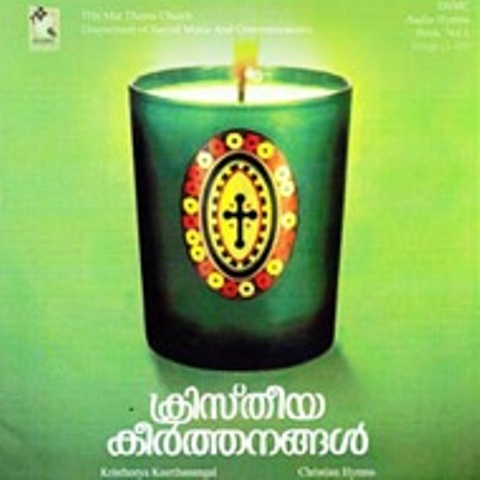
Kristeeya Keerththanangal
15 May, 1857: Birth of Rev. Thomas Koshy (Aatmopakari Achen), author of Hymn “Ennullil ennum vasichchiduvan”. Born as a member of the Mukkadavu family of Kallada, he became a priest in 1896. He was a gifted artist, hymn writer and publisher. He was a speaker of the Maramon Convention for many years.
Hymn Nos. 10(9), 37(35), 190(179), 216(201), 20(205), 221(206), 246(224), 297(283), 316(311), 344, and 352 in the Hymn Book Kristheeya Kerthanagal are written by him.
Read more in our Short Biographies: Rev. Thomas Koshy (Aatmopakari Achen) (Free PDF)

18 April, 1929: Sadhu Sunder Singh disappears
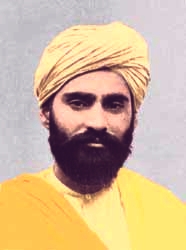
Sadhu Sundar Singh
18 April, 1929: Sadhu Sunder Singh (b.3 Sep 1889) disappears on his way to Tibet. The mystery of the disappearance of Sadhu Sunder Singh after leaving Sabathu-near Tibet on 18th April 1929 has never been solved. The route he was to have taken was one he had often traveled before. Reports of his disappearance appeared in newspapers all over the world.
No one knows what happened to him and how he died. By whatever means God took His servant home, He evidently did not intend it to be known. Sunder manifested into his life the verse written in Mark 8:35 which says, “For whoever wants to save his own life will lose it; but whoever loses his life for me and for the Gospel will save it.”
Read more in our Free PDF Ebook:
https://nalloorlibrary.com/wp-content/uploads/2013/05/sadhu-sunder-singh.pdf

1799 – Formation of the Church Missionary Society
12 April, 1799: Formation of the Church Missionary Society. Founded in 1799, CMS has attracted more than nine thousand men and women to serve as mission partners during its 200-year history.
The Society was founded in Aldersgate Street in the City of London on 12 April 1799. The founders of CMS were committed to three great enterprises: abolition of the slave trade, social reform at home and world evangelisation.
“The contribution made by the society in creating and maintaining educational institutions in Kerala, the most literate state in India, is significant. Many colleges and schools in Kerala and Tamil Nadu still have CMS in their names. The CMS College in Kottayam may be one of the pioneers in popularising secondary education in southern India.”
“Benjamin Bailey was appointed to the Kottayam CMS mission in the Indian state of Kerala. Benjamin Bailey translated the complete Bible to Malayalam language. Also Authored the first printed Malayalam-English dictionary and the first Malayalam-English Dictionary. He is considered as the father of Malayalam Printing.”
Today there are about 150 mission partners in 26 countries in Africa, Asia, Europe and the Middle East. A budget of £7.02 million a year is needed to maintain and expand this work.
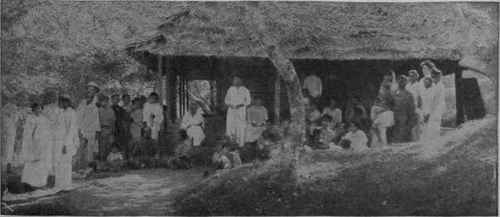
A daily scene at Thiruvananthapuram (Trivandrum, Kerala, India). Patients waiting outside the CMS dispensary. (Photo Credit: chestofbooks.com)


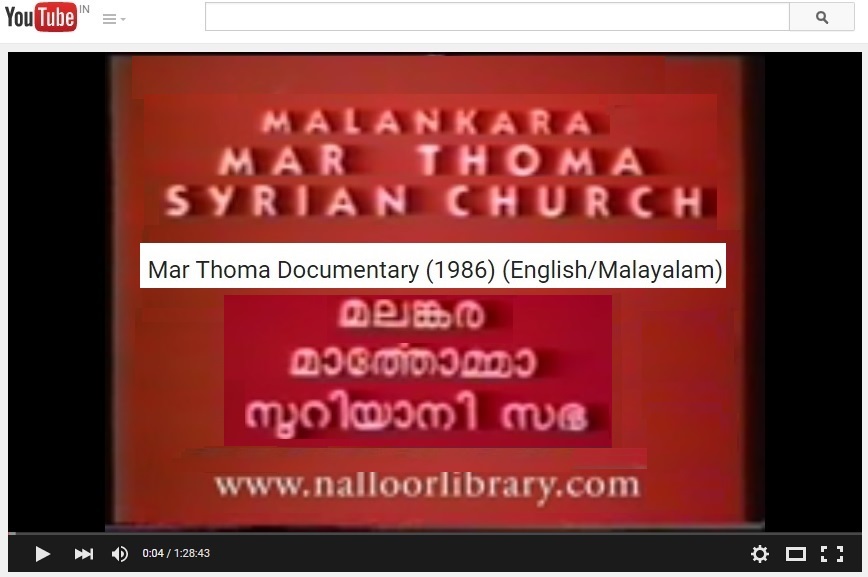
Rare 1986 Documentary on the Malankara Mar Thoma Syrian Church
A Must Watch Special Documentary with rare footage on the Malankara Mar Thoma Syrian Church – (English/Malayalam) produced in 1986. It offers a peek into the history, rich culture and heritage of the Mar Thoma Syrian Church.
A Malaysian presentation in conjunction with the 150th Anniversary of the REFORMATION in the Malankara Mar Thoma Syrian Church. (Please watch and share).
Free pdf Ebooks for Children to read during their School Holidays

Free pdf Ebooks for Children to read during their School Holidays
Mary Jones and her Bible
(inspired the founding of the British and Foreign Bible Society)
http://goo.gl/8A2OQA
Thampi’s Heart (English) – A story adapted from Christian Folklore
http://goo.gl/HO71eu
Robert Raikes – Founder of Sunday School
http://goo.gl/FPTGuA

8 March 1835, Freedom for Kerala Slaves. (Munro Island – Travancore)

Slaves
Slavery was a social evil which prevailed all over the world including what is now the state of Kerala in India. According to the 1836 census there were 164,864 slaves in Travancore vis-à-vis a total civilian population of 12,80,668.
Slaves were treated like animals and the cost of one slave was that of an ox, cost of an ox was 5 (big para) measures of Paddy or Rs. 10/- only. Slaves were chained and sold like animals in markets.
Kottayam, Changanasserry, Thirunakkara, Alleppey, Kayamkulam, Kollam, Attingal, Chirayinkizh, Kaniyapuram, Pettah and Kovalam were the notorious slave trade markets of the time. Churches in Cochin were used as godowns for the slaves except for Sundays. Slaves were exported out of the kingdom. There was no one to speak on behalf of these unfortunate people.
With the arrival and the teachings of the CMS (Church Missionary Society) missionaries, people became aware of this social evil. In 1819, Munro Island was given to the missionaries, by the then Travancore Government along with the slaves residing there on the Island. Munro Island is located at the confluence of Ashtamudi Lake and the Kallada River, in Kollam district, Kerala, India.
In 1833, England passed the Slavery Abolition Law. CMS missionaries, Benjamin Bailey and Joseph Peet made a historic declaration on 8th March 1835, giving freedom to the slaves in Munro Island.
The declaration read as follows:
“We the undersigned, acting as trustees of Munro Island, do hereby declare that… who has hitherto been a slave of the soil, is from this time liberated by us and made a free man and that his wife and offspring are wholly and forever free and are regarded by us only as hired servants and that no one has any right to bring them into servitude again. At the same time we declare that we do not consider ourselves as released from any claim which he or his wife or offspring may have upon us according to custom, privilege or law in consequence of their having been slaves.”
8 March 5. Sd/- Benj Bailey Sd/- Josh Peet,
In 1847, Uthram Thirunal Marthanda Varma became the King of Travancore. The same year CMS missionaries submitted a memorandum to the King requesting him to stop the slavery in Travancore. In 1853, by royal declaration slavery was abolished in Travancore forever. In 1864, the Kingdom of Cochin also made a similar declaration abolishing slavery.
3 March, 1547: Seventh Session of the Council of Trent
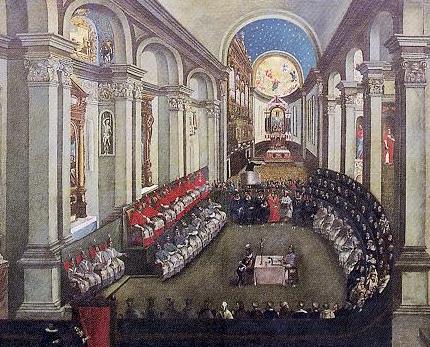
The Council of Trent meeting in Santa Maria Maggiore church, Trento (Trent). (Artist unknown; painted late 17th century.)
At the Seventh Session of the Council of Trent, the Roman Catholic Church defines its theology of the sacraments. Arguing that seven sacraments are necessary for salvation; Baptism, Confirmation, the Eucharist, Penance, Extreme Unction, Orders, and Matrimony; the council rejected the teaching of most Protestants that only two were required: Baptism and the Lord’s Supper.
“Sthuthippin sthuthippin Yesudevane” – Unchanged final hymn from the first Maramon Convention in 1895
The Hymn “Sthuthippin sthuthippin Yesudevane, Halleluiyah paadi sthuthippeen sthuthippen yesudevane” written by Rev. Yusthus Joseph (Vidhuwan Kutty Achen) (1835-1887) is sung by the complete congregation at the close of the final meeting of each year’s convention. This may be a world record for the same hymn being sung every year at the same time since the year 1895.
Rev. Yusthus Joseph (Vidhuwan Kutty Achen) (1835-1887) has written 26 out of the total 427 hymns in the Kristeeya Keerthanangal (hymn book used by the Mar Thoma Syrian Church).
Kristeeya Keerthanangal
According to the Late Metropolitan Most. Rev. Dr. Juhanon Mar Thoma, Vidhuwan Kutty Achen had a vital role in the Revival movement of the Mar Thoma Church “The spiritual revival started by an unknown preacher Mathai Upadesi and carried on by Rev. Yusthus Joseph (Vidhuwan Kutty), a famous scholar and musician and a Brahmin convert, had its influence throughout Central Travancore. – “Christianity in India and a brief history of the Mar Thoma Syrian Church” by Most. Rev. Juhanon Mar Thoma.
Read more about Rev. Yusthus Joseph (Vidhuwan Kutty Achen) in our free pdf ebook.
https://nalloorlibrary.com/wp-content/uploads/2013/06/ebook-vidhuwan-kutty-achen.pdf
The original composition by in Carnatic music style is still performed by classical singers.



 Nalloor Library