Pages from History: 6 October, 1536: Church executes William Tyndale
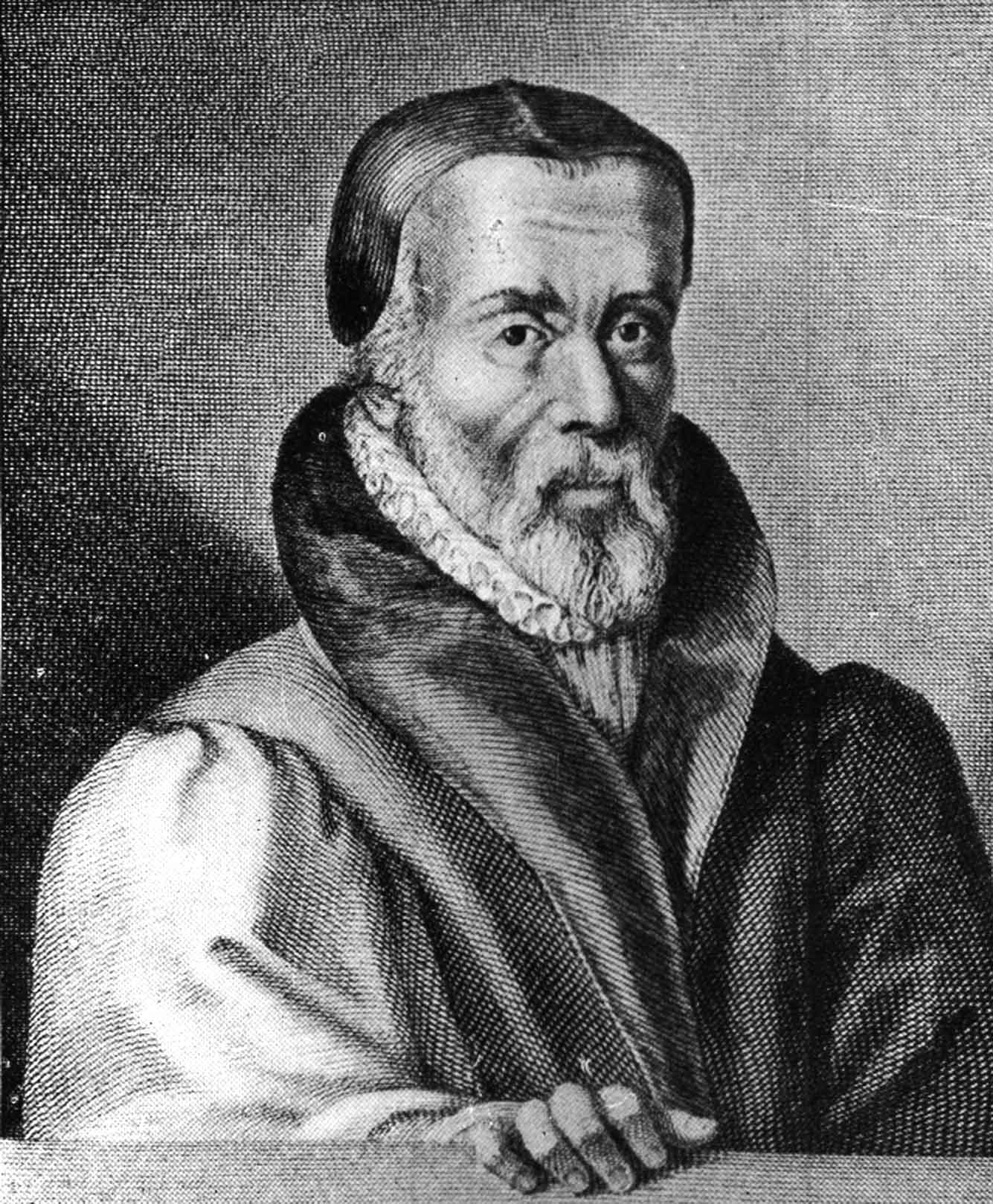
William Tyndale
6 October, 1536: Church executes William Tyndale (b.1494).
The first English version of the Bible made by direct translation from the original Hebrew and Greek, and the first to be printed, was the work of William Tyndale. He met bitter opposition from the main Church. He was accused of willfully perverting the meaning of the Scriptures and his New Testaments were to be burned as “untrue translations”.
He was finally betrayed into the hands of his enemies and on 6 October 1536, was publicly executed and burned at the stake by the Catholic Church.
Pages from History: 27 September, 1947: Formation of Church of South India (with Photos)
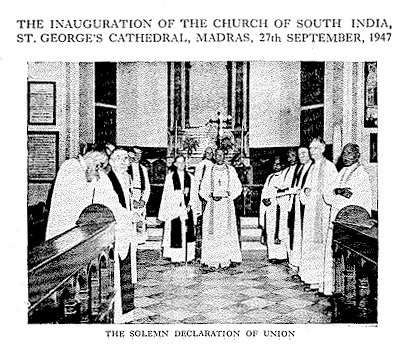
Photo credit: http://www.csisynod.com
27 September, 1947: Formation of Church of South India (CSI) in 1947, as a union of Anglican, Presbyterian, Congregationalist and Methodist churches. The idea of a Church union was proposed in 1919 at a conference held in Tranquebar (now Tarangambadi) in 1919. After 28 years of discussions various denominational churches in South India established by different Missionary societies agreed to the formation of the Church of South India in 1947 after India attained independence. The inaugural ceremony was held at St. George Cathedral Madras (Chennai).
Today the Church of South India is one of the largest Protestant churches in India and is a member of the Anglican Communion and its bishops participate in the Lambeth Conferences. It is also a member of the World Council of Churches, the World Alliance of Reformed Churches, and the National Council of Churches in India.
The Church of South India (CSI), Church of North India (CNI), and Malankara Mar Thoma Syrian Church of India jointly formed the Communion of Churches in India (CCI) in 1978 for mutual recognition of the ministry and leaders, inter communal relationship, and to explore possibilities of working together and other areas of cooperation in the fulfillment of the mission of the Church in India.
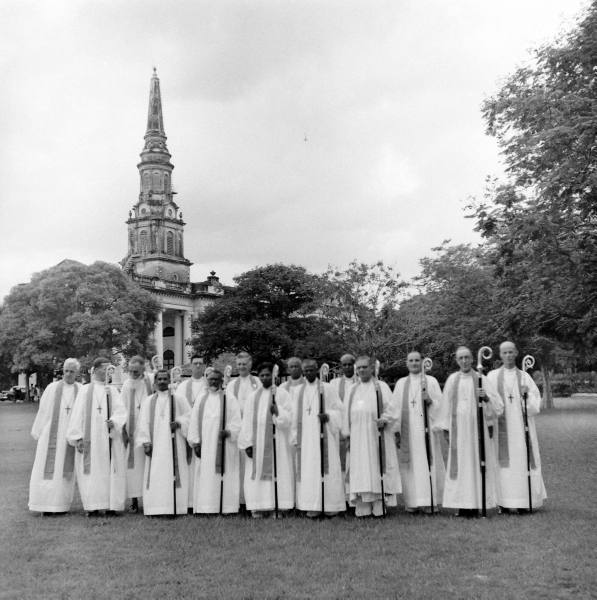
At the inauguration of Church of South India. Photo by Mark Kauffman (LIFE magazine)
The presiding bishop of the inaugural function was the Rt. Revd. C. K. Jacob of the Anglican Diocese of Travancore and Cochin. A vast congregation gathered in the cathedral at Madras from all over the world. The following historical declaration was made by Bishop Jacob at the inaugural service.
“Dearly beloved brethren, in obedience to the Lord Jesus Christ the head of the church, who on the night of his passion prayed that his disciples might be one, and by authority of the governing bodies of the uniting churches whose resolutions have been read in your hearing and laid in your prayer before Almighty God; I do hereby declare that these three churches, namely – the Madras, Madura, Malabar, Jaffna, Kannada, Telugu, Travancore Church councils of the South India United Church; the Methodist Church of South India, Trichinopoly, Hyderabad and Mysore districts; the Madras, Travancore and Cochin, Tinnevelly and Dornakal dioceses of the Churches of India, Burma and Ceylon; are become one Church of South India, and these bishops, presbyters, deacons and probationers who have assented to the basis of union and accepted the constitution of the Church of South India, whose names are laid upon this holy table, are bishops, presbyters and deacons of this church. In the name of the Father, and the Son, and the Holy Spirit, Amen.” ~ wikipedia

Inauguration procession of Church of South India. Photo by Mark Kauffman (LIFE magazine)
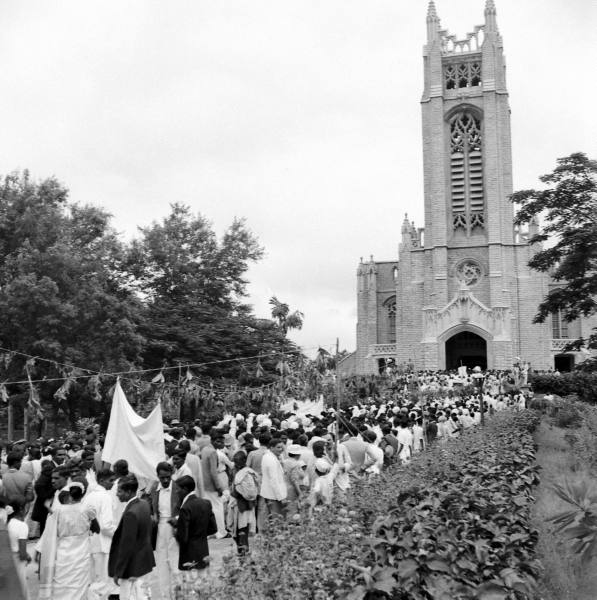
Inauguration procession of Church of South India. Photo by Mark Kauffman (LIFE magazine)
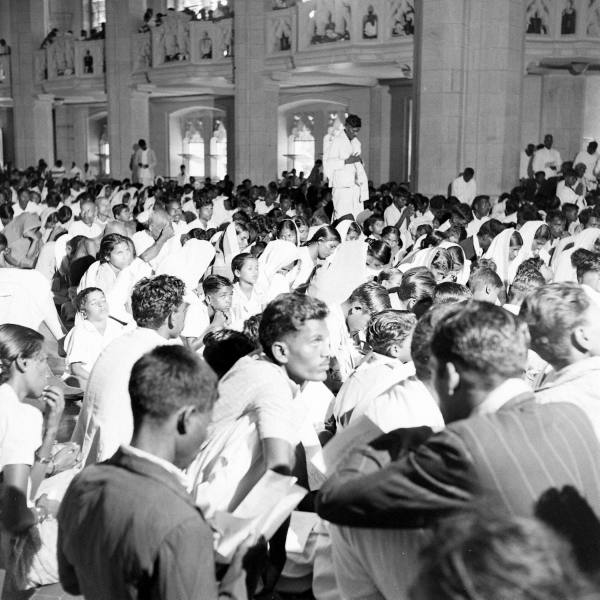
Inauguration service of Church of South India. Photo by Mark Kauffman (LIFE magazine)
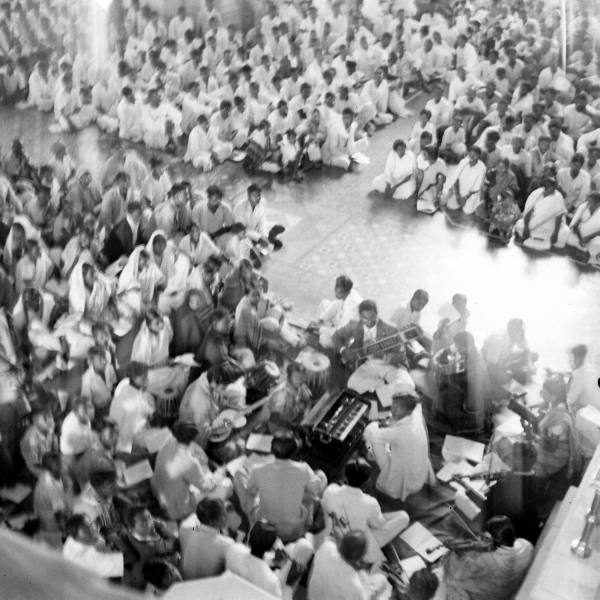
Inauguration service of Church of South India. Photo by Mark Kauffman (LIFE magazine)

Inauguration service of Church of South India. Photo by Mark Kauffman (LIFE magazine)
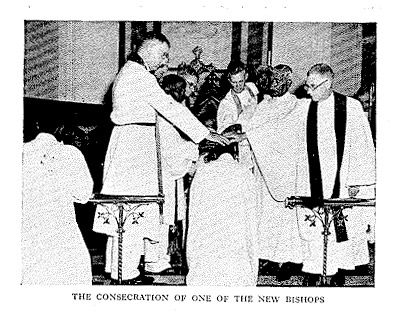
Photo credit: http://www.csisynod.com
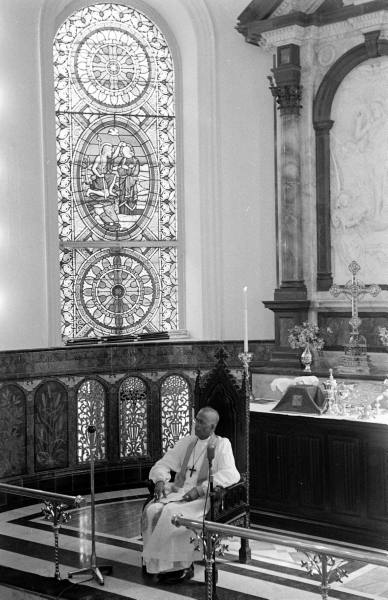
Presiding Bishop Rt. Revd. C. K. Jacob at the Inauguration of Church of South India. Photo by Mark Kauffman (LIFE magazine)
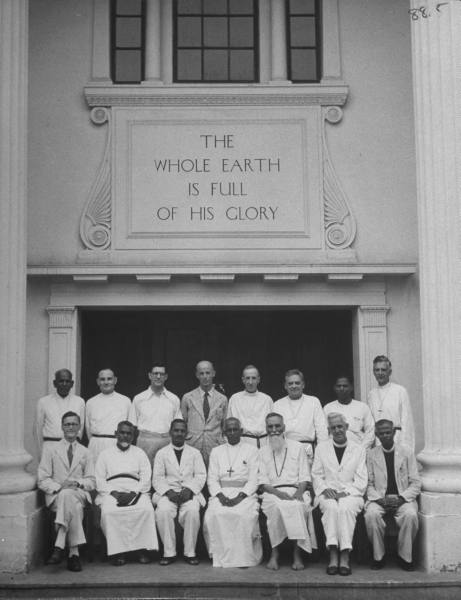
Clergymen from 5 Protestant faiths attending the inaguration of the Church of South India. Photo by Mark Kauffman (LIFE magazine)

St George’s Cathedral, Chennai (photo credit – wiki)
Pages from History: 27 September, 1976: Juhanon Mar Thoma Metropolitan passes away

Metropolitan Juhanon Mar Thoma (Photo credit: LIFE magazine)
27 September, 1976: Juhanon Mar Thoma Metropolitan Passes away. (b.7 Aug.1893) .Dr Juhanon Mar Thoma was the Metropolitan of the Mar Thoma Syrian Church from 1947 to 1976. He provided the Church with the emblem having the motto: “Lighted to Lighten”. This has been appreciated by many leaders of Christian churches.
“Ecumenism was a reality for him; he restored peace with the Indian Orthodox Church. He actively participated in ecumenical councils such as the World Council of Churches. In 1948, he led the delegation to the first Assembly of the World Council of Churches in Amsterdam. At its second meeting at Evanston, Illinois in 1954 he was elected as one of the presidents of WCC. During the third Assembly in New Delhi in 1961 he was the chairman and guided the deliberations with distinction.
It was in 1974, it was decided enter into full communion with the Churches of South India, North India and with various provinces in the Anglican communion.” ~ wikipedia.com
On 26 June 1975 the then Prime Minister of India Indira Gandhi declared Emergency. Juhanon Mar Thoma was the only Christian leader in India who raised a voice and sent a letter to the Prime Minister arguing for the restoration of democracy.
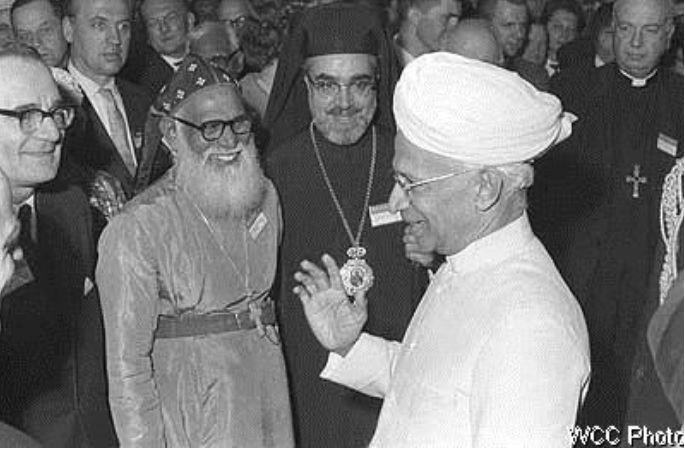
Dr Radhakrishnan, vice-president of India (right) greeting Bishop S. U. Barbieri, Metropolitan Juhanon Mar Thoma and Archbishop Iakovos during the Third Assembly of the WCC in New Delhi, November 18 – December 6, 1961. (Photo from the Archives of wcc-coe.org)
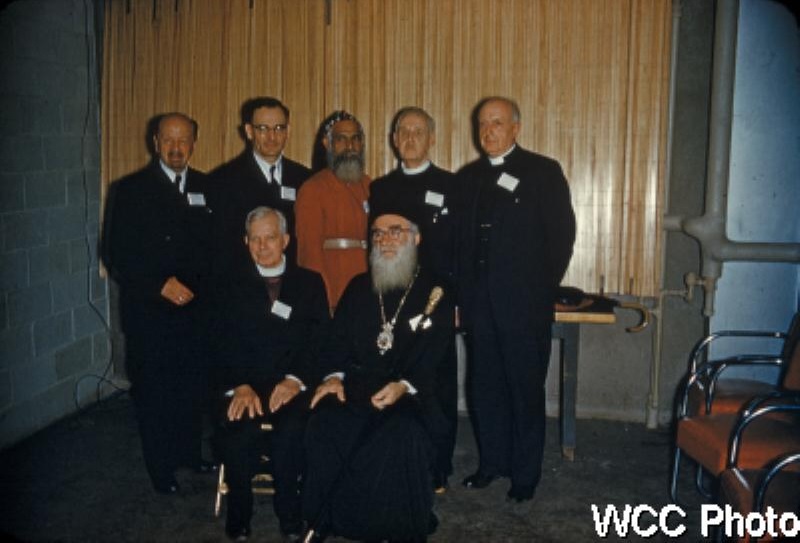
The six new elected Presidents of the World Council of Churches (1954).
Standing, left to right, the are Bishop Dibelius of the Evangelical Church of Germany, Bishop Barbieri of the Methodist Church in Argentina, Metropolitan Juhanon of the Mar Thoma Syrian Church of Malabar, India, the Very Rev. John Baillie of the Church of Scotland, Bishop Sherril of the Protestant Episcopal Church of the U.S.A.
Seated, left to right, Bishop bell of the Church of England (Honorary President), Archbishop Michael of the Eastern Orthodox Church in North and South America. (Photo from the Archive of wcc-coe.org)
Pages from History: 15 September, 1853: First woman ordained in the United States
15 September, 1853: Antoinette Brown Blackwell becomes the first female minister ordained in America. Antoinette Brown, (May 20, 1825 – November 5, 1921), was the first woman to be ordained as a minister in the United States, when she was called to be the pastor of the Congregational church in South Butler, New York in 1853. Her ordination, however, was not recognized by her denomination. In 1857, she returned to her work as an orator and reformer for womens rights with her husband Samuel C. Blackwell. She also was a strong activist for the right to vote for women. She died at the age of 96 in Elizabeth, New Jersey.
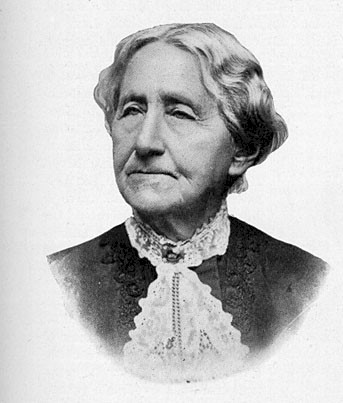
Antoinette Brown Blackwell
Pages from History: 4 September, 1847: Henry Francis pens Hymn ‘Abide with me’
4 September, 1847: Henry Francis Lyte (1793-1847) writes the Hymn “Abide with me” (Malayalam – Koode paarkka neram vaikkunnitha, No.8 (7) in Kristheeya Keerththanagal). Lyte wrote this hymn at the end of his life, just two months before he died. The text for this Hymn was taken from Luke’s Gospel Ch.24 v. 29 “Abide with us; for it is toward evening, and the day is far spent”.
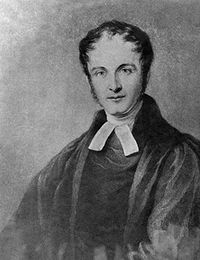
Henry Francis Lyte
Pages from History: 14 July, 1947, Punchamannil Mammen Upadeshi passes away
14 July, 1947: Punchamannil Mammen Upadeshi passes away. Mammen Upadeshi was born in the Vadasseri house of the Punchamannil family in Maramon on 25 Nov.1868, as the son of Mathai and Achiyamma.
Mammen’s elder siblings all died while they were still infants. So Mammen was baptized at home when he was very young by the Parish Priest Rev. Titus (Later Rt. Rev. Titus I Mar Thoma).
Mammen Upadeshi trusted the Lord like the Old Testament Prophet Elijah and lived like Elijah, spoke the messages of the Lord like Elijah, fought against evil forces like Elijah and even performed miracles like Elijah.

Punchamannil Mammen Upadeshi
Pages from History. 10 July, 1919: P.V. Thommy Upadeshi passes away
10 July, 1919: P.V. Thommy Upadeshi passes away. Thommy Upadeshi was born in a very poor family of the Kunnamkulam Mar Thoma Parish in 1881. After his basic education he became a teacher. But after few years of teaching he became a full time evangelist in the Mar Thoma Church.
Rev. C.M. Joseph, Vicar of the Kunnamkulam Parish encouraged him in his Gospel work. Titus II Metropolitan appointed him as evangelist in Trichur and Perumbavoor He was a blessed Hymn writer. In 1905 he published a Hymn Book “Vishudha Geethangal” comprising of 136 hymns.
His language is simple and even the illiterate persons can enjoy his hymns. The following hymns in the book Kristheeya Keerththanangal are written by him: 3 (3), 11(10), 12(11), 30(28), 56(56), 61(61), 67(67), 70(70), 71(71), 73(73), 96(96), 130(111), 35(126), 145(136), 243(221), 247(225), 286(286), 295(281), 345 (345), 351(351), 366(242), 368(251).
In 1919 there was an outbreak of Cholera in Kunnamkulam and many persons died. Thommy Upadesi volunteered to serve the cholera patients and was finally infected with cholera. He passed away on Wednesday 10 July 1919 at the age of 38.

Kristheeya Keerththanangal
Pages from History: 5 July 1415, Church burns John Hus
5 July, 1415: John Huss, Bohemian preacher and forerunner of Protestantism, is burned as a heretic in Constance, Germany. John Huss was a religious thinker and reformer. He initiated a religious movement based on the ideas of John Wycliffe.
His followers became known as Hussies. The Catholic Church did not condone such uprisings, and Huss was excommunicated in 1411, condemned by the Council of Constance. Hus was offered a chance to recant and declined with the words “God is my witness that the things charged against me I never preached. In the same truth of the Gospel which I have written, taught, and preached, drawing upon the sayings and positions of the holy doctors, I am ready to die today.” He was then burned at the stake, and his ashes thrown into the Rhine River.

Jon Hus being burnt at the Stake.
Janíček Zmilelý z Písku – Jena codex
Pages from History: 1 July 1899, Formation of The Gideons International
1 July, 1899: Three travelling businessmen met in a YMCA building and decided to form an organization to distribute Bibles. The Christian Commercial Men’s Association of America, later renamed the Gideon’s, placed their first Bibles in a hotel nine years later.
Gideon’s started their work in India in 1961. The 33rd annual convention of Gideon’s International (India) was held at Tiruvalla in May, 2002.
Gideon’s distribute complete Bibles, New Testaments, or portions thereof. They have placed 1.9 billion Scriptures and are on a mission to reach 2 billion.

The Gideons International
Pages from History: 27 June, 1880, Birth of Helen Keller
27 June, 1880: Birth of Helen Keller (d.1 June 1968) in Tuscumbia, a little town of northern Alabama, USA.
As a baby of nineteen months, Helen Keller was stricken with a severe illness which left her totally blind and deaf. Then Anne Mansfield Sullivan a English teacher came to teach her and there began that remarkable story of her development into a woman of great culture and spiritual insight.
Helen Keller devoted her life to helping blind and deaf-blind people. She appeared before US state and national legislatures and international forums, travelled around the world to lecture and to visit areas with a high incidence of blindness, and wrote numerous books and articles. She is known as a symbol of Hope for blind people across the world.

Miss Sullivan reading to Miss Keller, circa 1898 (http://www.afb.org)


 Nalloor Library