Pages from History: 27 September, 1947: Formation of Church of South India (with Photos)
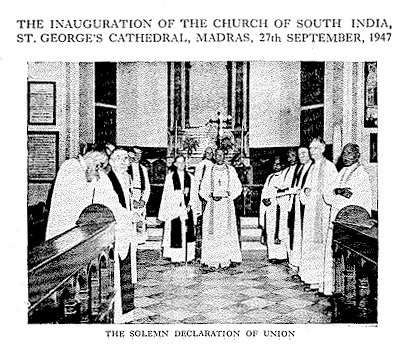
Photo credit: http://www.csisynod.com
27 September, 1947: Formation of Church of South India (CSI) in 1947, as a union of Anglican, Presbyterian, Congregationalist and Methodist churches. The idea of a Church union was proposed in 1919 at a conference held in Tranquebar (now Tarangambadi) in 1919. After 28 years of discussions various denominational churches in South India established by different Missionary societies agreed to the formation of the Church of South India in 1947 after India attained independence. The inaugural ceremony was held at St. George Cathedral Madras (Chennai).
Today the Church of South India is one of the largest Protestant churches in India and is a member of the Anglican Communion and its bishops participate in the Lambeth Conferences. It is also a member of the World Council of Churches, the World Alliance of Reformed Churches, and the National Council of Churches in India.
The Church of South India (CSI), Church of North India (CNI), and Malankara Mar Thoma Syrian Church of India jointly formed the Communion of Churches in India (CCI) in 1978 for mutual recognition of the ministry and leaders, inter communal relationship, and to explore possibilities of working together and other areas of cooperation in the fulfillment of the mission of the Church in India.
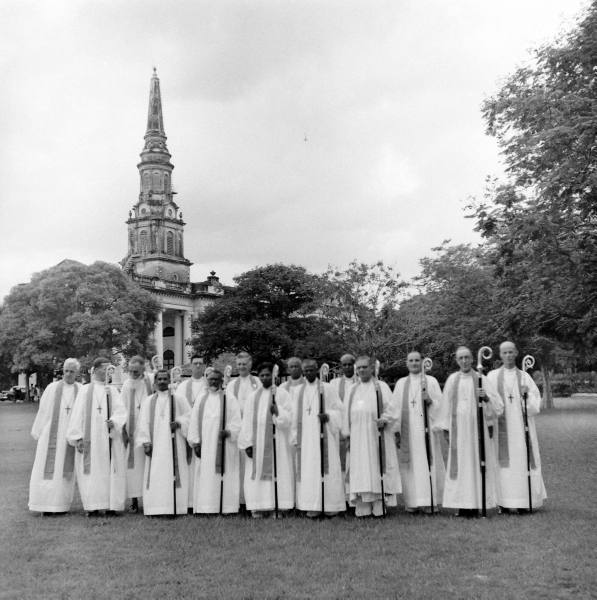
At the inauguration of Church of South India. Photo by Mark Kauffman (LIFE magazine)
The presiding bishop of the inaugural function was the Rt. Revd. C. K. Jacob of the Anglican Diocese of Travancore and Cochin. A vast congregation gathered in the cathedral at Madras from all over the world. The following historical declaration was made by Bishop Jacob at the inaugural service.
“Dearly beloved brethren, in obedience to the Lord Jesus Christ the head of the church, who on the night of his passion prayed that his disciples might be one, and by authority of the governing bodies of the uniting churches whose resolutions have been read in your hearing and laid in your prayer before Almighty God; I do hereby declare that these three churches, namely – the Madras, Madura, Malabar, Jaffna, Kannada, Telugu, Travancore Church councils of the South India United Church; the Methodist Church of South India, Trichinopoly, Hyderabad and Mysore districts; the Madras, Travancore and Cochin, Tinnevelly and Dornakal dioceses of the Churches of India, Burma and Ceylon; are become one Church of South India, and these bishops, presbyters, deacons and probationers who have assented to the basis of union and accepted the constitution of the Church of South India, whose names are laid upon this holy table, are bishops, presbyters and deacons of this church. In the name of the Father, and the Son, and the Holy Spirit, Amen.” ~ wikipedia

Inauguration procession of Church of South India. Photo by Mark Kauffman (LIFE magazine)
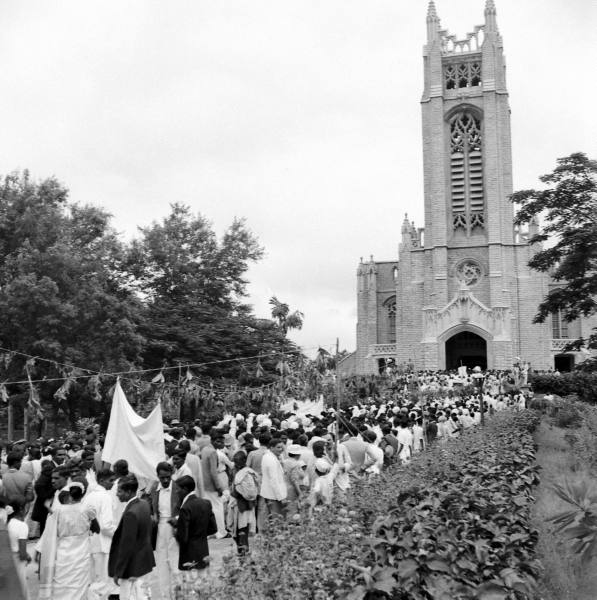
Inauguration procession of Church of South India. Photo by Mark Kauffman (LIFE magazine)
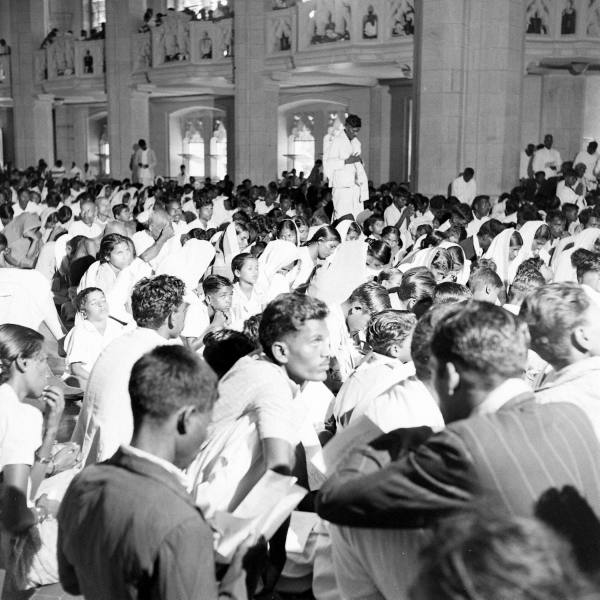
Inauguration service of Church of South India. Photo by Mark Kauffman (LIFE magazine)
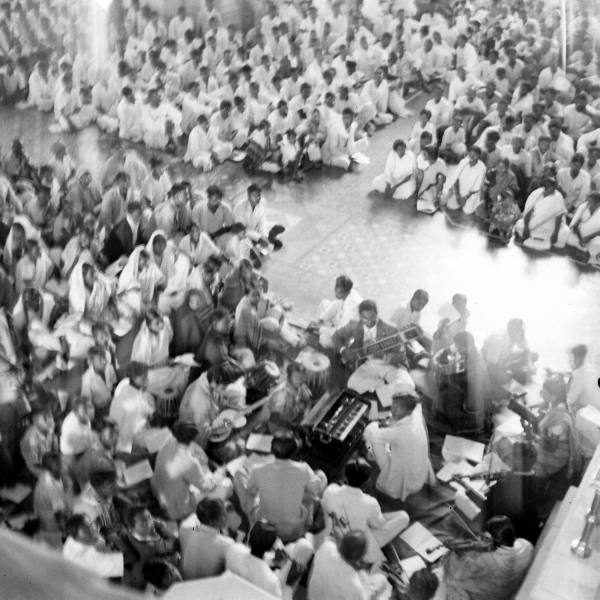
Inauguration service of Church of South India. Photo by Mark Kauffman (LIFE magazine)

Inauguration service of Church of South India. Photo by Mark Kauffman (LIFE magazine)
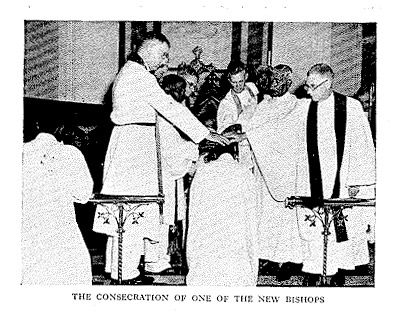
Photo credit: http://www.csisynod.com
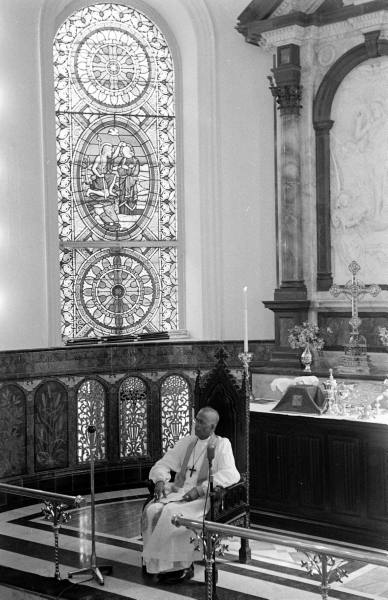
Presiding Bishop Rt. Revd. C. K. Jacob at the Inauguration of Church of South India. Photo by Mark Kauffman (LIFE magazine)
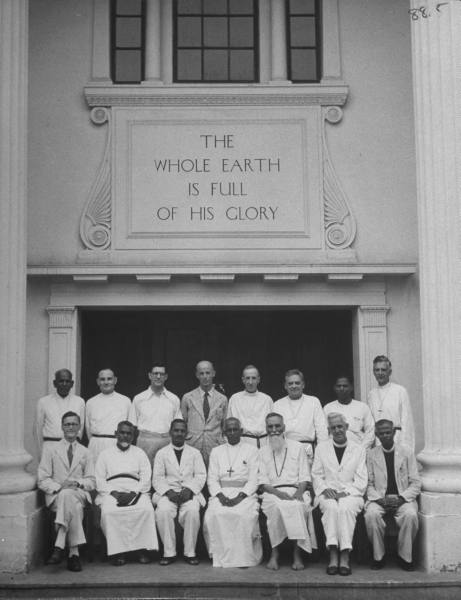
Clergymen from 5 Protestant faiths attending the inaguration of the Church of South India. Photo by Mark Kauffman (LIFE magazine)

St George’s Cathedral, Chennai (photo credit – wiki)
Pages from History: 27 September, 1976: Juhanon Mar Thoma Metropolitan passes away

Metropolitan Juhanon Mar Thoma (Photo credit: LIFE magazine)
27 September, 1976: Juhanon Mar Thoma Metropolitan Passes away. (b.7 Aug.1893) .Dr Juhanon Mar Thoma was the Metropolitan of the Mar Thoma Syrian Church from 1947 to 1976. He provided the Church with the emblem having the motto: “Lighted to Lighten”. This has been appreciated by many leaders of Christian churches.
“Ecumenism was a reality for him; he restored peace with the Indian Orthodox Church. He actively participated in ecumenical councils such as the World Council of Churches. In 1948, he led the delegation to the first Assembly of the World Council of Churches in Amsterdam. At its second meeting at Evanston, Illinois in 1954 he was elected as one of the presidents of WCC. During the third Assembly in New Delhi in 1961 he was the chairman and guided the deliberations with distinction.
It was in 1974, it was decided enter into full communion with the Churches of South India, North India and with various provinces in the Anglican communion.” ~ wikipedia.com
On 26 June 1975 the then Prime Minister of India Indira Gandhi declared Emergency. Juhanon Mar Thoma was the only Christian leader in India who raised a voice and sent a letter to the Prime Minister arguing for the restoration of democracy.
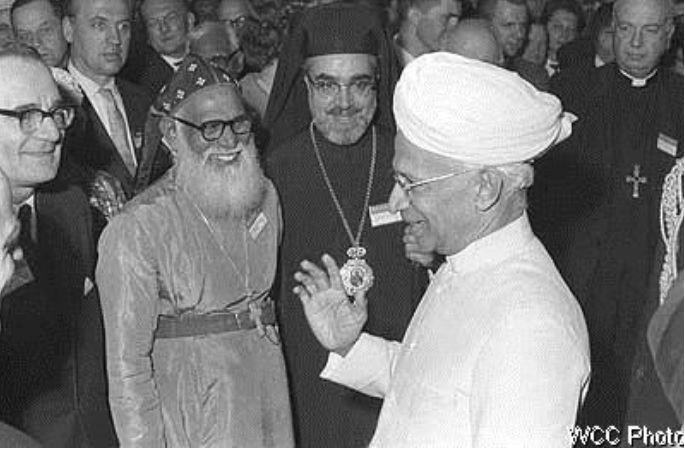
Dr Radhakrishnan, vice-president of India (right) greeting Bishop S. U. Barbieri, Metropolitan Juhanon Mar Thoma and Archbishop Iakovos during the Third Assembly of the WCC in New Delhi, November 18 – December 6, 1961. (Photo from the Archives of wcc-coe.org)
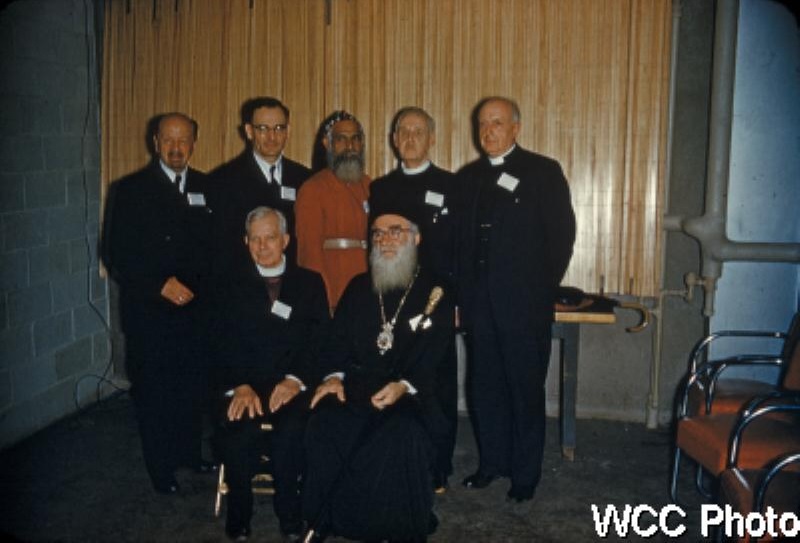
The six new elected Presidents of the World Council of Churches (1954).
Standing, left to right, the are Bishop Dibelius of the Evangelical Church of Germany, Bishop Barbieri of the Methodist Church in Argentina, Metropolitan Juhanon of the Mar Thoma Syrian Church of Malabar, India, the Very Rev. John Baillie of the Church of Scotland, Bishop Sherril of the Protestant Episcopal Church of the U.S.A.
Seated, left to right, Bishop bell of the Church of England (Honorary President), Archbishop Michael of the Eastern Orthodox Church in North and South America. (Photo from the Archive of wcc-coe.org)
Pages from History: 17 September 1917, Birth of M. E. Cherian
17 September, 1917: Birth of M. E. Cherian, author of “Anugrahaththin Adhipathiye”.
Cherian was the son of Kuriannoor Thannikkapurathuttu T. M. Easow (Kunjachen Upadeshi) and Ayroor Kanjeettukara Panamthottathil Aleyamma. At the age of 9 he accepted Jesus as his personal saviour. He taught at the Noel Memorial School in Kumbanad for a few years, and from 1943 onwards he started full time gospel work.
He has written more than 300 hymns and 13 books. Hymn nos. 92, 93, 94, 95, 233, 236, 238, 239, 241, 245, 248, 304, 364, 365, 379, 385, 386 and 409 in the Mar Thoma Syrian Church Hymn book (Kristheeya Keerththanangal) are written by him.
He was called to his eternal home on 2 October, 1993 while he was on a gospel trip in Muthukulathoor Village near Madurai in Tamil Nadu.

M. E. Cherian
Pages from History: 15 September, 1853: First woman ordained in the United States
15 September, 1853: Antoinette Brown Blackwell becomes the first female minister ordained in America. Antoinette Brown, (May 20, 1825 – November 5, 1921), was the first woman to be ordained as a minister in the United States, when she was called to be the pastor of the Congregational church in South Butler, New York in 1853. Her ordination, however, was not recognized by her denomination. In 1857, she returned to her work as an orator and reformer for womens rights with her husband Samuel C. Blackwell. She also was a strong activist for the right to vote for women. She died at the age of 96 in Elizabeth, New Jersey.
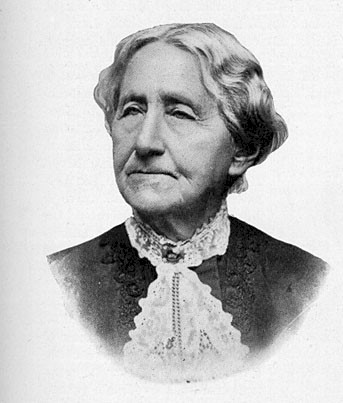
Antoinette Brown Blackwell
Pages from History: 14th September 407, Archbishop John Chrysostom dies
14 September, 407: Early church father John Chrysostom, the greatest preacher of his age, dies in exile when, in poor health, he is forced to travel on foot in bad weather. He was the Archbishop of Constantinople.

John Chrysostom
Pages from History: 4 September, 1847: Henry Francis pens Hymn ‘Abide with me’
4 September, 1847: Henry Francis Lyte (1793-1847) writes the Hymn “Abide with me” (Malayalam – Koode paarkka neram vaikkunnitha, No.8 (7) in Kristheeya Keerththanagal). Lyte wrote this hymn at the end of his life, just two months before he died. The text for this Hymn was taken from Luke’s Gospel Ch.24 v. 29 “Abide with us; for it is toward evening, and the day is far spent”.
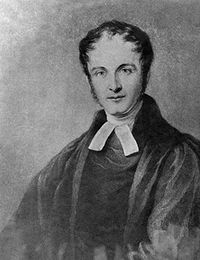
Henry Francis Lyte
Pages from History: 3 September, 1889 – Birth of Sadhu Sunder Singh
Sadhu Sunder Singh was a member of an ancient, aristocratic, and wealthy Sikh family from the village of Rampur in the State of Patiala. He was very religious. Jesus appeared to him in a vision in the early hours of 18th December 1904. Like Paul he heard a voice “Why do you persecute me? Remember that I gave my life for you upon the Cross”. On Sunday, the 3rd of September, 1905, on his sixteenth birthday, he was baptized in St. Thomas Church at Simla according to the rite of the Anglican Church.
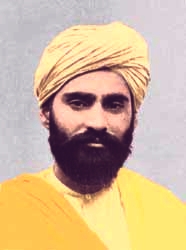
Sadhu Sundar Singh
A month after his baptism, Sundar Singh donned the yellow linen robe that celibate Indian Sadhus wore and set out to preach the gospel, carrying nothing but a New Testament. From now on he would have no permanent home and no income.”I am not worthy to follow in the steps of my Lord,” he said, “but like Him, I want no home, no possessions. Like Him I will belong to the road, sharing the suffering of my people, eating with those who will give me shelter, and telling all people of the love of God.’ He also authored eight books.
He is believed to have died in the foothills of the Himalayas in 1929 on his way to Tibet. His body was never found.
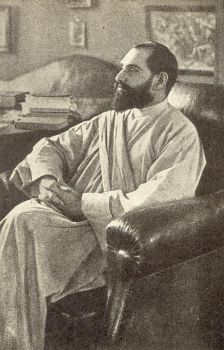
Sadhu Sundar Singh
Pages from History: 31 August, 1688: John Bunyan dies.
English Puritan writer and preacher John Bunyan, author of “Pilgrim’s Progress” dies at the age of 69. Though one of England’s most famous authors even in his own day, he maintained his pastoral duties to his death, which was caused by pneumonia he caught while riding in the rain to reconcile a father and son.

John Bunyan

John Bunyan’s grave at Bunhill Fields, London.
Pages from History, 29 July, 1955: Mr. Daniel files suit against Mar Thoma Metropolitan
K. Ninan Daniel
On 29 July, 1955, Mr. Ninan Daniel, of Kurumthottikkal, Melukara Pathanamthitta District and three others filed a civil suit in District Court of Kottayam against the then Metropolitan of the Mar Thoma Church Most Rev. Juhanon Mar Thoma and six others.
Pages from History: 14 July, 1947, Punchamannil Mammen Upadeshi passes away
14 July, 1947: Punchamannil Mammen Upadeshi passes away. Mammen Upadeshi was born in the Vadasseri house of the Punchamannil family in Maramon on 25 Nov.1868, as the son of Mathai and Achiyamma.
Mammen’s elder siblings all died while they were still infants. So Mammen was baptized at home when he was very young by the Parish Priest Rev. Titus (Later Rt. Rev. Titus I Mar Thoma).
Mammen Upadeshi trusted the Lord like the Old Testament Prophet Elijah and lived like Elijah, spoke the messages of the Lord like Elijah, fought against evil forces like Elijah and even performed miracles like Elijah.

Punchamannil Mammen Upadeshi