Birth Anniversary of Mr. M. T. Joseph (Co-founder of Hoskote Mission) 21 October, 1910
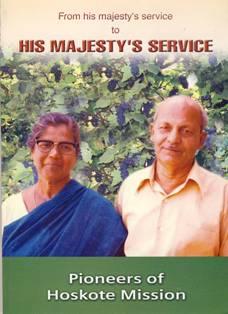
21 October, 1910: Birth of Mr. M. T. Joseph (d.18 Feb,1995) ), Co-founder of the Hoskote Mission. Joseph was the son of Ipe Thomas and Rachelamma of Manon, Maramon. He was an Anchel Master (Post Master) who left his lucrative government job and home town, to go to an unknown village far away in rural Karnataka, with the sole purpose of spreading the Gospel.
The Hoskote Mission Medical Center was established in 1947 in Hoskote, Bangalore Rural District, Karnataka.
Read more about his story : https://nalloorlibrary.com/wp-content/uploads/2013/06/ebook-m-t-joseph-co-founder-of-hoskote-mission.pdf
25th October 2015: Family Sunday Service (Free Malayalam pdf EBook)
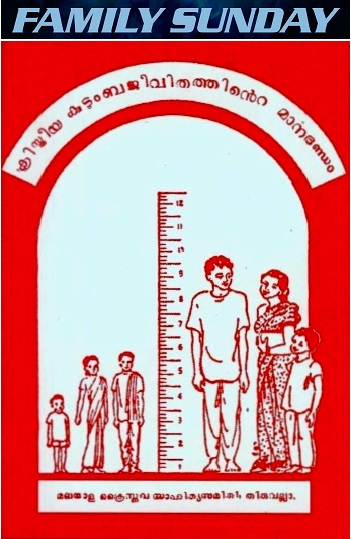
The Principles of Christian Family Life (Malayalam)
On 25th October 2015 (20th Sunday after Pentecost), Family Sunday is celebrated by the CSI church, CNI church and the Mar Thoma Syrian Church. The focus of the service is on the “Faith that has to be formulated in family life”.
Download this free pdf Ebook published in Malayalam in 1951 that is still relevant to today’s Christian life. This book can be used as a resource for your Family Sunday service. The link can be shared and used by church members, parishes and church organziations. It can be accessed on any smartphone, tablet or computer for free.
The Principles of Christian Family Life (Malayalam) (Published in 1951)


Remembering the Mahatma of the Mar Thoma Church (Freedom Fighter) Rare Photos and Video
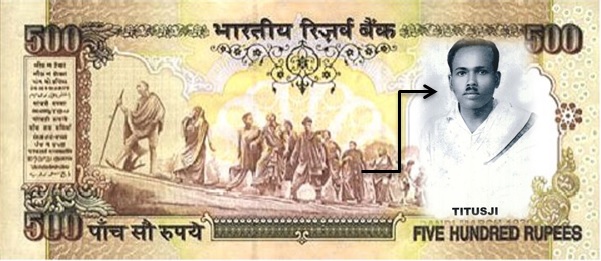
The Christian priest on the Indian Rs. 500 note to represent Titusji the only Christian in the Dandi Salt March along with Mahatma Gandhi. (Currency note used for illustrative purposes only)
Everyday millions of Indians use the Indian 500 Rupee note with the image of the historic Dandi Salt march by Mahatma Gandhi in 1930 that triggered the wider Civil Disobedience Movement leading to India’s freedom from the British. Among the marchers that would change India’s destiny was just one Christian and a Mar Thomite, Shri Thevarthundiyil Titus also known as ‘Titusji’. He is represented on the Indian Rs. 500 note as a “Christian Priest” (circled in blue in the image above). However he was sidelined and never received a pension from the Central Government, State Government or Freedom Fighter’s Associations. His own Church, the Mar Thoma Syrian Church seems to have no recollection of him or given him due recognition. Tituji’s home Parish, Maramon Mar Thoma Church or the Bhopal Parish St.Peter’s Mar Thoma Church which began in his residence have all but forgotten their illustrious son and his contribution to the nation’s freedom.
The image on the Indian 500 Rupee note is that of a sculpture made in tribute of the march in the heart of Delhi city, on the Sardar Patel Marg. The sculpture shows ten Indian people following Gandhi on his path-breaking civil disobedience protest, hence the name “Gyarah Murti” (Eleven Statues). The Christian priest was included to represent the only Christian in the march – Titusji. A devout Gandhian – he was known by the name Titus in his earlier days. “Titusji” was the name given to him by Mahatma Gandhi as a token of love and honour.
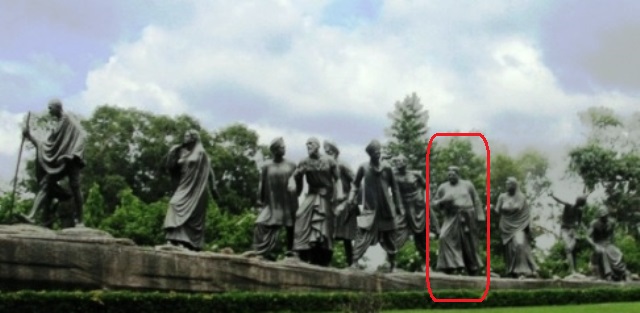
“Gyarah Murti” or “Eleven Statues with the priest highlighted in Red to represent Titusji who the lone Christian in the Dandi Salt March.
“Gandhi’s iconic retinue in the sculpture includes a woman with her head covered following close after him; a cluster of three men including a turbaned Sikh visibly of high pedigree, a Hindu scholar with a topi and an emaciated Muslim peasant; a Hindu man wearing a turban as a mark of intellectual distinction, with a religious mark etched on his forehead; an impoverished peasant looking far ahead, bearing no marks of class, caste or religion on his body; a Christian priest; another woman in a skirt and a young boy egging on a weary old man to travel farther.” ~ www.sodelhi.com

About Titusji
Titusji (b.18 Feb, 1905) hailed from a farming family, (Theverthundiyil, Maramon) in Kerala. He was a member of the Maramon Mar Thoma Parish. After his high school graduation, he taught in a school in Vadasserikkara (a village about 20 km away from Maramon), for a few years and then joined the Allahabad Agriculture University and cleared an Indian Dairy Diploma course with distinction.
Titusji-The Freedom Fighter
Gandhiji’s way of life, his principles and his simplicity greatly influenced Titusji that he decided to join Gandhiji’s Ashram named” Goshala “in Sabarmati. The lifestyle there was simple and austere, to say the least. All the inmates in the Ashram were allowed only two pairs of clothing and every one had to do his own chores. Early morning after prayers and two hours of charkha, each one was assigned his or her duties.He was selected by Mahatma Gandhi as a secretary for his milk project in the Sabarmati Ashram near Ahmedabad. Mr. Gulzarilal Nanda (who later became acting prime mister of India) was the secretary of another unit. Both of them were trusted friends of Gandhiji. Titus got married in 1933, to Annamma (Ikarethu House, Kozhencherry). Annamma, after her marriage, joined the Sabarmati Ashram and she donated her wedding ornaments to the Ashram. Gandhiji was very keenly interested in the activities of the dairy at the Ashram .It was in these formative years that Titusji got to know Gandhiji personally and his commitment to the freedom struggle was made stronger.
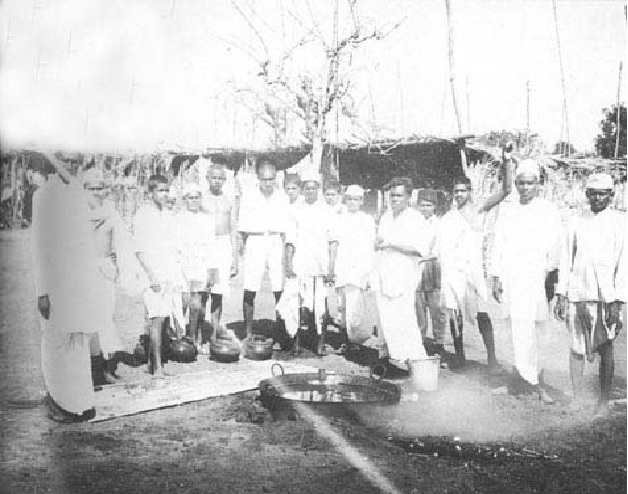
Titusji at the Dandi Salt March (4th from right) 1930
The Dandi March
.In 1930, when Mahatma Gandhi decided to break the salt law, he chose trusted Titus to be one of the selected 80 men. On March 12, 1930, Gandhi and 78 male satyagrahis set out, on foot, for the coastal village of Dandi, Gujarat, some 240 miles from their starting point in Sabarmati. Titusji was one of the satyagrahis who accompanied Gandhi in this historic event known as “Dandi March” or “The Salt Satyagraha.” Titusji was the only Christian in that group. They were beaten up and arrested by the British Police. Titusji was arrested during the march to the Dharasana Salt depot. He was initially imprisoned in the Jalalpur jail and subsequently shifted to the Nasik jail.
An interesting observation about Titusji’s participation in the Dandi march was that he was not wearing the Gandhi cap during the march. Apart from him, Gandhiji was the only other person who did not wear a cap. When some of the other marchers complained to Gandhiji about it, Gandhiji took the stand that no one should be compelled to wear one.
On being released from the prison, Titusji went back to the Sabarmati Ashram. In 1932 Gandhiji asked him to take charge of the ‘Goshala’ (Dairy farm) at the Ashram again. It was while he was here in 1933 that his marriage took place to Annamma, a caring, warm person who supported Titusji in all his difficult times.
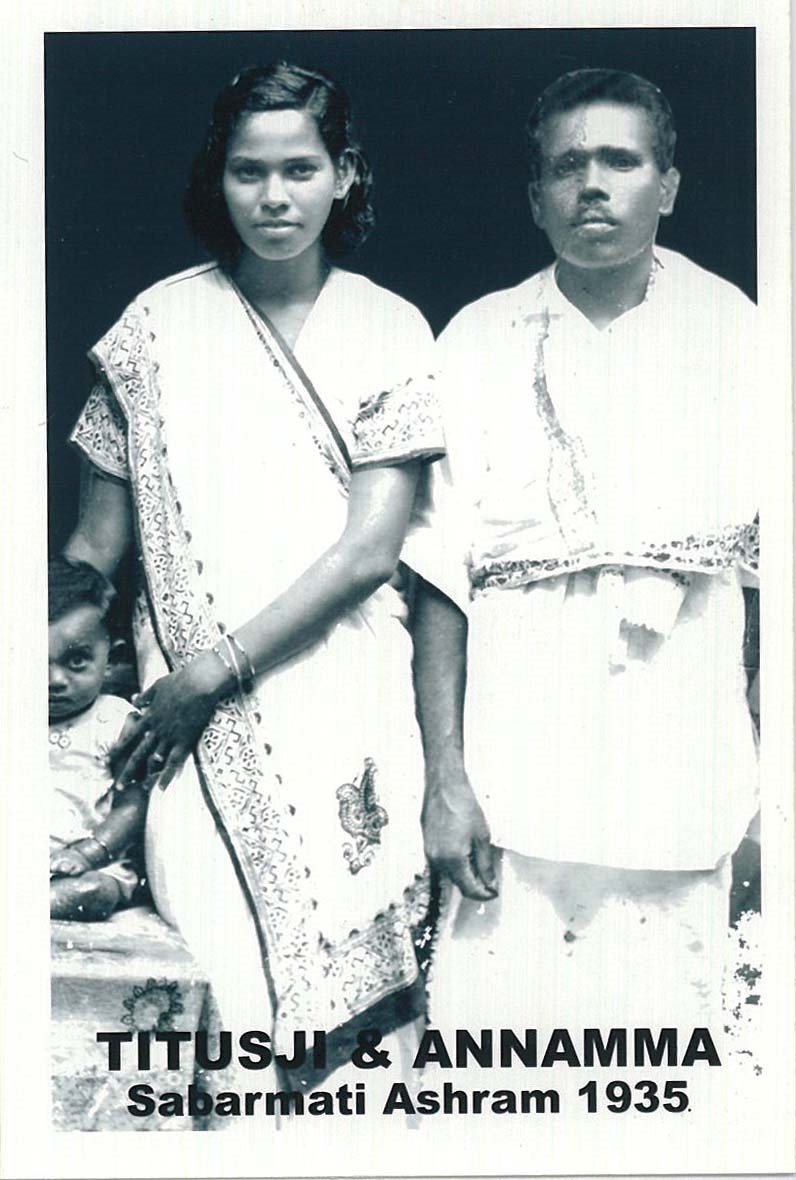
Titusji and his wife Annama with daughter Aleyamma at Sabarmati Ashram 1935.
Titusji’s eldest daughter Aleyamma was born when he was at Sabarmati Ashram. In 1933, Gandhiji suddenly decided to disband the Ashram .Gandhiji’s instructions to Titusji was that he take the entire cattle out of the Ashram and protect the cattle. Following Gandhiji’s orders, Titusji shifted all the cattle and staff members out of the ashram and took shelter in a Panjrapole (animal shelter). Titusji slept in the stables beside the cattle through out the monsoon He worked hard to keep up the various activities of the Goshala. It was a tough life but since hardships were a way of life, Titusji did not have any problem obeying such orders.
Mahatma Gandhi’s Visit to Kerala – 1934
During one of his visits to Travancore (Kerala) Titusji burnt British-made clothes (foreign clothes) in Kottayam and gave a fiery speech to thousands of Malayalees to join the freedom movement.
Mahatma Gandhi visited Titusji’s house in Maramon (Theverthundiyil) in 1934 on his way to the famous Hindu temple in Aranmula near Chengannur. He assured Titusji’s father that his son is safe and sound. This was considered one of the greatest events in Central Travancore. In and around Maramon, thousands witnessed his visit.
Involvement in Dairy
Gandhiji by this time was totally busy travelling the length and breadth of the country in mobilizing the masses for the cause of independence. In-spite of his hectic schedules he still took interest in the activities of the ‘Goshala’ (Dairy farm) and was in touch with Titusji. Gandhiji in one of his letters to Titusji in 1933 wrote “I wanted to come and see the ‘Goshala’ (Dairy farm), but it was impossible for me to spare the time during the few hours that I was in Ahmedabad….I knew however that you were working very hard to make the ‘Goshala’ (Dairy farm) a success and to keep it in a clean condition….. I want you to write to me from time to time telling me all about the progress of the ‘Goshala’ (Dairy farm).”
Then in the middle of 1935, Gandhiji decided to handover the entire ashram property including ‘Goshala’ (Dairy farm) to the Harijan Sevak Sangh and then the Sabarmati Ashram thereafter ceased to be the hub of activities as far as the freedom movement was concerned. Titusji then worked in various Dairy farms as Manager in different parts of India. Due to the frequent change of places, his elder children Aleyamma, Titus and Easow stayed with relatives in Travancore .Then during the time of independence he was in Delhi as Manager with Keventers Diary.
In the early 50’s, Titusji moved to Jabalpur and then to Bhopal. His family now included the addition of four more sons Joseph, George, John and Thomas. He had one daughter and six sons. He then took a job as a Manager in Bairagarh Dairy, Bhopal, Madhya Pradesh.
A couple of years later the Bairagarh Dairy closed down and the family had to go through a lot of hardships. Titusji had to sell off the family car and even his property in Maramon, Kerala. But he refused to ask for any special privileges as a freedom fighter. He then got a break by getting a Government job in Obaidullaganj as instructor in an Institute training Village Level Workers. It was a job of his liking. He stayed alone in Obaidullaganj and would return to Bhopal on Saturdays for the weekend and go back on Mondays. In those days a song sung by Mohammed Rafi ‘Suno suno ye Bapuji ki Amar Kahani ’was a favourite of his and used to be played in the Institute regularly.
The family kept shifting their residences in Bhopal from one rented house to another. After many ups and downs, Titusji managed to get a loan of Rs.16,000 and bought a piece of land in the Noor-Mahal area of Bhopal. The entire family worked hard to build the house which was promptly named ‘Lake View Cottage’ since it afforded a clear view of the Bhopal Lake. At that time, there were no other houses in the neighbourhood. The family shifted to this house in 1956.
In 1962, Titusji got a job in Bhilai Steel Plant establishing the dairy unit in the Bhilai Steel Plant Township. He arranged for the collection of milk from nearby villages and introduced for the first time pasteurization and bottling of milk with pilfer-proof aluminium foil using imported machines. This was then distributed to all the sectors of the township.
After retiring from Bhilai Steel Plant, Titusji worked with a Christian NGO in Siliguri, West Bengal. Later he shifted to Sodpur in 24 Parganas, West Bengal. Thereafter he served the World Council of Churches (Bengal Refugee Services) in Calcutta.
At this point of time he had to face personal loss. On 2nd of December 1964, his second son, 24 year old Joy suddenly had a heart attack in his office and died. The funeral was attended by thousands. But cruel fate had more in store for him. On 12th April 1965, barely two months after the sixtieth birthday of Titusji, his beloved wife Annamma passed away. She died of post operative complications after having undergone an operation for appendicitis.
Inspite of all the setbacks Titusji remained active in his work. He was selected by the Birla group for setting up a dairy in the township of Hindustan Motors in Uttarpara, near Calcutta. He did this successfully and then re-settled in Bhopal in 1972 for a quiet life with his children and grand children.
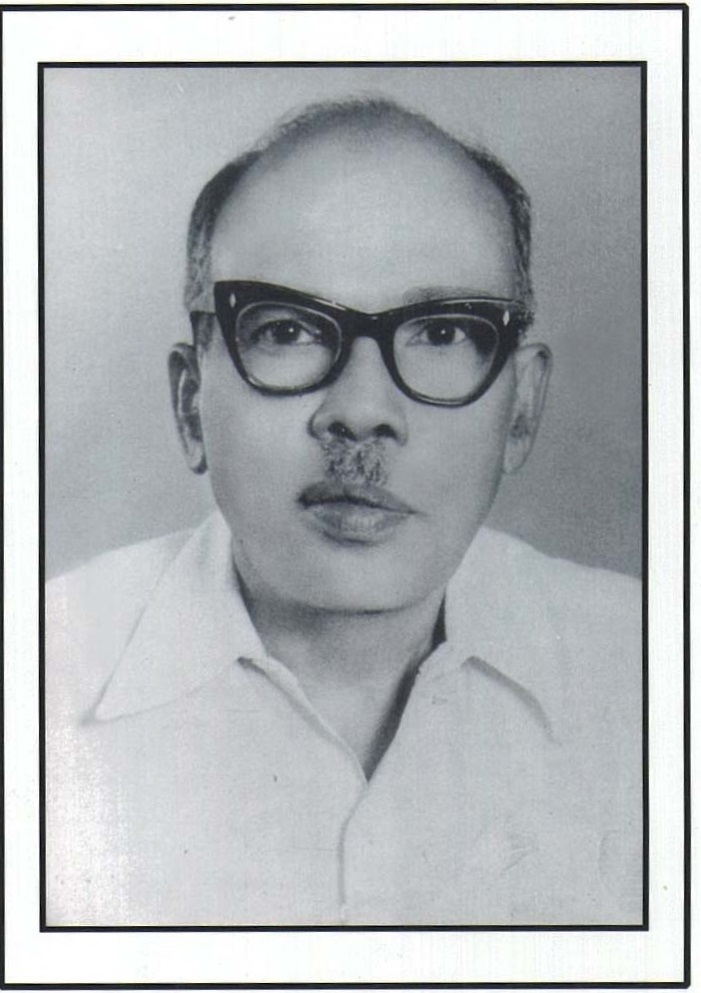
Titusji in his later years
Titusji- A man of faith
Titusji had immense faith in God. This helped him to overcome the trials and tribulations in his life. His honest and simple way of life made it easier for him to lead the life of a true Christian. He believed in the dignity of the individual, irrespective of his or her origin or status. He strived to help the fellow human beings in which ever way he could. Titusji being one of the few Malayali gazetted officers in Bhopal in the early 50’s, helped many Keralites who used to come to him to get their certificates attested and also in case of other difficulties .His was one home to which people could turn to without hesitation and ask for any help. Annamma, his wife had this habit of visiting the nearby Government Hospital and offering food or any possible help to anyone needy. Having experienced tough days themselves, they knew the importance of helping out the unfortunate,the lesser privileged.
In Bhopal Titusji initiated the forming of a Christian Congregation. A few Marthomites who were in Bhopal in the fifties started the Sunday worship in October 1954 at the residence of Titusji. That was the beginning of the Bhopal parish and was a congregation of all Christian denominations except the Roman Catholics. As the number of members grew, the space became inadequate and the Sunday service was shifted to other spacious halls and later to local church buildings. He was an active and a well-known member of the St.Peter’s Mar Thoma Church, Bhopal. Titusji was the driving force behind the establishment of Christa Prema Kulam Mission Field at Sehatganj, which is on the Bhopal-Sagar National Highway, about 25 kms from Bhopal City. The land for the Ashram was given by him at a nominal cost.This mission field is currently doing commendable work in uplifting the condition of the rural people living in the area.
In 1970, he published the book “The Bharat of my Dreams” in which he revealed his hope for the nation,and for its teeming millions. He firmly believed that all are equal and hence there should not be any disparity.
He had one daughter and six sons. He passed away on 8 August, 1980, at the Kasturba Hospital in Bhopal and was buried in the Christian Cemetery there. He never got any medals or pension for his participation in the freedom struggle. We salute his humbleness, patriotism, and dedication to the nation.
It is a matter of great pride to the Mar Thoma Syrian Church that it had men of such vision like Titusji, who worked untiringly for the freedom of the country. We praise and thank God for such leaders like Mr. and Mrs. Titus of Bhopal on his death anniversary on 8th August and the country’s Independence Day on 15th August.
How can you not share this story with others. We hope that it will inspire more youth from our Church to be involved in nation building with selflessness and pure thoughts.
In a unique tribute to commemorate the historic Dandi Salt march by Mahatma Gandhi in 1930, India’s Ministry of Culture is working on setting up a National Dandi Salt Satyagraha Memorial. IIT Bombay has been charged with the responsibility to design, coordinate and implement the memorial project. The main memorial will include a statue of Gandhi inside a pyramid of light, followed by the life-size sculptures of the 80 marchers who participated in the Salt March. www.dandimemorial.org
*With inputs and photos from Ms. Renu Thomas, granddaughter of Titusji and Mr. & Mrs. John Titus (son and daughter in law of Titusji).

29 July 1955: Daniel Case – St. Thomas Evangelical Church of India separates from the Mar Thoma Syrian Church (Rare Photos)
K. Ninan Daniel
29 July, 1955: Mr. Daniel files suit against Mar Thoma Metropolitan. On 29 July 1955 Mr. Nina Daniel, of Kurumthottikkal, Melukara Pathanamthitta District and three others filed a civil suit in District Court of Kottayam against the then Metropolitan of the Mar Thoma Church Most Rev. Juhanon Mar Thoma and six others. Mr. K.N. Daniel, was a lay leaders in the Mar Thoma Church, an eminent liturgiologist, theologian, an author of many books, a prominent lawyer. 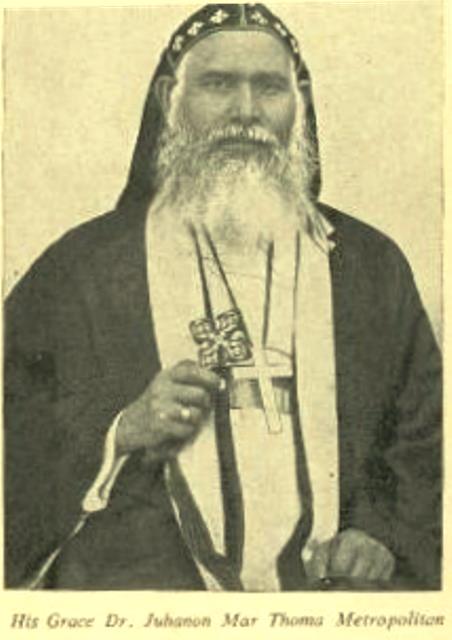 According to Mr. Daniel, the Metropolitan favoured and accepted the faith of the Jacobite Church and as such he had no right to enter any Mar Thoma Churches and that he should not be allowed to continue as the Supreme Head of the Church. This case is known as the Daniel case. This litigation lasted for almost 10 years and the final judgment from the Supreme Court of India came on 7 Jan 1965. In all the three courts (The District court, Kerala High Court and the Supreme Court) verdicts were against Mr. Daniel.
  This case was an unfortunate event in the history of the Mar Thoma Syrian Church and resulted in the formation of the St. Thomas Evangelical Church of India on 26 January 1961. Twenty priests who had been ordained in the Mar Thoma Church joined and pledged allegiance to the new Church.

- First defendant Most Rev. Juhanon Mar Thoma Metropolitan was examined through the judicial commission in the Mar Thoma Seminary in Kottayam. His examination took 35 hours over seven days.
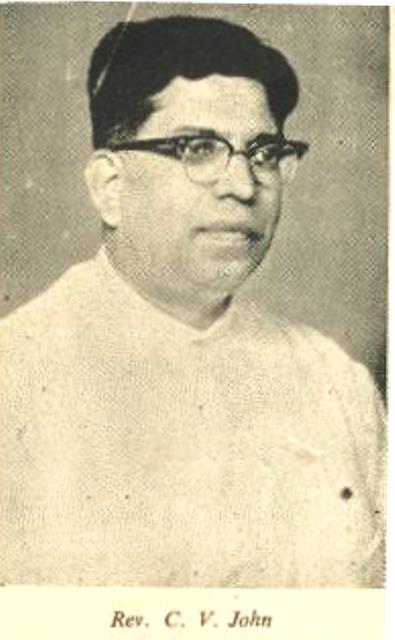 Second defendant Rev. C.V.John was examined for 11 days continuously 6 hours each day. (Total 66 hours)
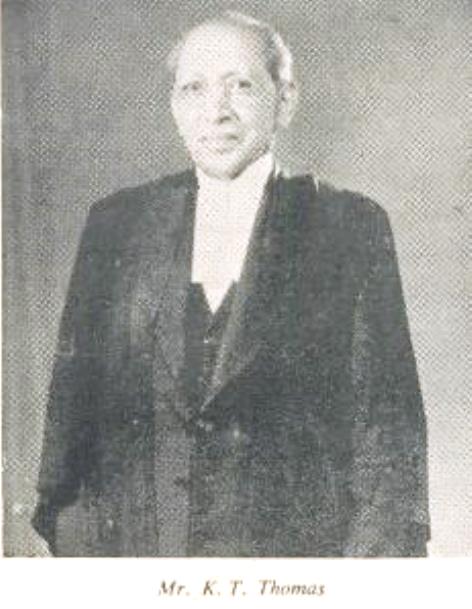 Adv. K.T.Thomas appeared before all the three courts for the Mar Thoma Syrian Church without taking any remuneration. Total cost of the case was Rs. 13;239/- (today it could be in crores).
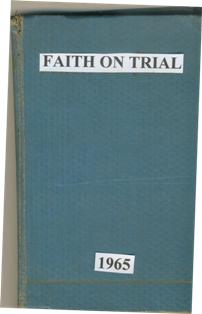
The book with all the details of the Daniel Case published in English (1965)
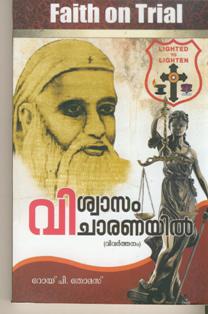
The Malayalam translation of the Daniel case from English.
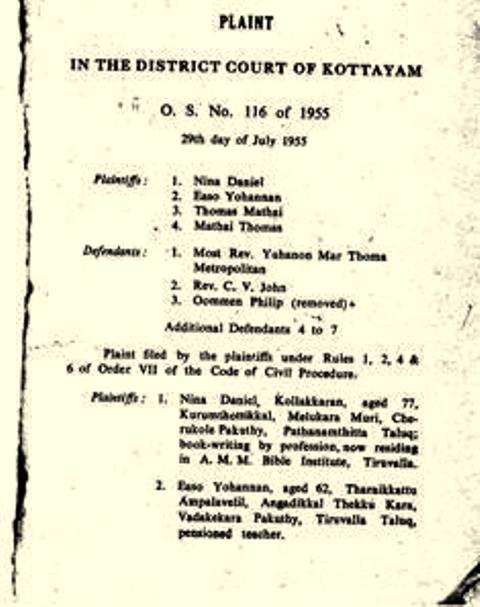
Excerpts of the Daniel case.
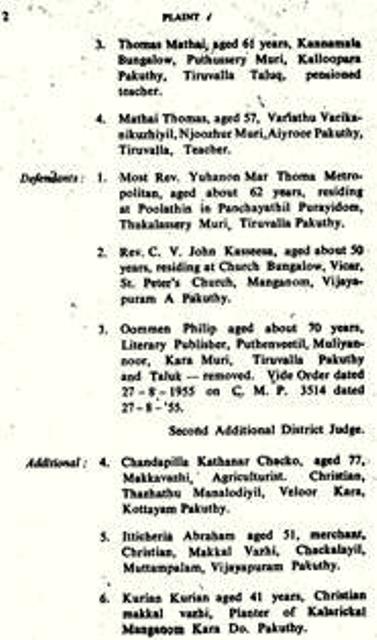
Excerpts of the Daniel case.
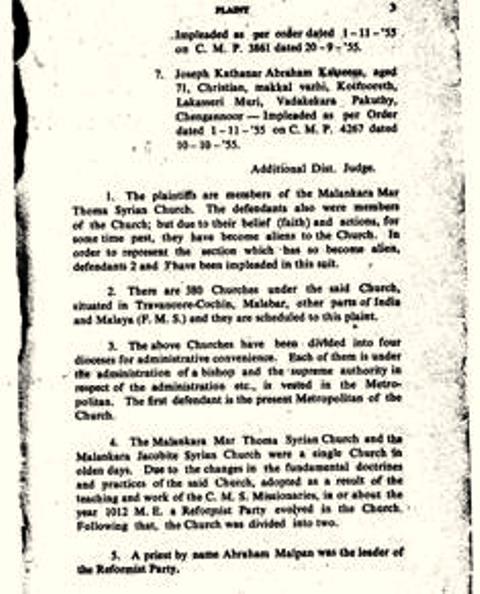
Excerpts of the Daniel case
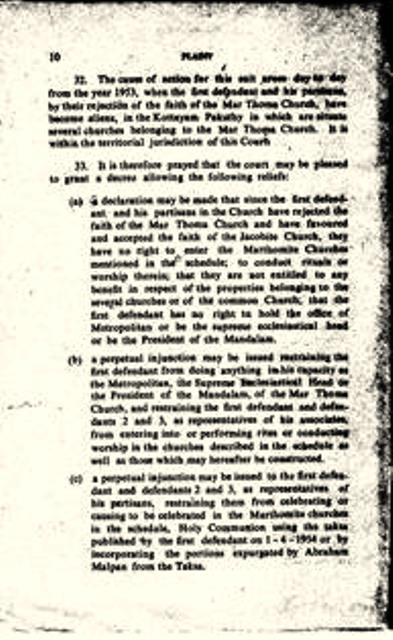
Excerpts of the Daniel case

10 July, 1919: Noted Hymn writer P.V. Thommy Upadesi passes away

P. V. Thommy Upadesi (Photo from ww.facebook.com/pvthommy)

Tombstone of P. V. Thommy Upadesi (Photo from ww.facebook.com/pvthommy)
10 July, 1919: P.V. Thommy Upadeshi passes away. Thommy Upadeshi was born in a very poor family of the Kunnamkulam Mar Thoma Parish in 1881. After his basic education he became a teacher. But after few years of teaching he became a full time evangelist in the Mar Thoma Church.
Rev. C.M. Joseph, Vicar of the Kunnamkulam Parish encouraged him in his Gospel work. Titus II Metropolitan appointed him as evangelist in Trichur and Perumbavoor
He was a blessed Hymn writer. In 1905 he published a Hymn Book “Vishudha Geethangal” comprising of 136 hymns. His language is simple and even the illiterate persons can enjoy his hymns. The following hymns in the book Kristheeya Keerththanangal are written by him: 3 (3), 11(10), 12(11), 30(28), 56(56), 61(61), 67(67), 70(70), 71(71), 73(73), 96(96), 130(111), 35(126), 145(136), 243(221), 247(225), 286(286), 295(281), 345 (345), 351(351), 366(242), 368(251).
In 1919 there was an outbreak of Cholera in Kunnamkulam and many persons died. Thommy Upadesi volunteered to serve the cholera patients and was finally infected with cholera. He passed away on Wednesday 10 July 1919 at the age of 38.
Read more P. V. Thommy Upadesi – Malayalam Hymn Writer

Margam Kali – The folk art of Syrian Christians 01
Margam Kali is a folk art form performed by womenfolk of Syrian Christians of central Kerala, India.
The word margam literally means ‘way’ or ‘path.’ This art was practiced by the St.Thomas Christians much before the arrival of the Portuguese and was essentially a medium of religious propagation. The theme of the dance is the stories related to the life and contributions of the apostle, St.Thomas.
In Margam Kali, a group of female dancers move rhythmically around a lighted wick lamp. The lamp represents Christ and the performers his disciples. The dancers wear their traditional chattayum mundum.
The video shows here is the Margam kali performance by Students of Nirmala Matha Central School, East Fort Thrissur, Kerala, India. (text and videos from http://www.indiavideo.org/)
Rare 1986 Documentary on the Malankara Mar Thoma Syrian Church
A Must Watch Special Documentary with rare footage on the Malankara Mar Thoma Syrian Church – (English/Malayalam) produced in 1986. It offers a peek into the history, rich culture and heritage of the Mar Thoma Syrian Church.
A Malaysian presentation in conjunction with the 150th Anniversary of the REFORMATION in the Malankara Mar Thoma Syrian Church. (Please watch and share).

Free pdf Ebooks for Children to read during their School Holidays

Free pdf Ebooks for Children to read during their School Holidays
Mary Jones and her Bible
(inspired the founding of the British and Foreign Bible Society)
http://goo.gl/8A2OQA
Thampi’s Heart (English) – A story adapted from Christian Folklore
http://goo.gl/HO71eu
Robert Raikes – Founder of Sunday School
http://goo.gl/FPTGuA

8 March 1835, Freedom for Kerala Slaves. (Munro Island – Travancore)

Slaves
Slavery was a social evil which prevailed all over the world including what is now the state of Kerala in India. According to the 1836 census there were 164,864 slaves in Travancore vis-à-vis a total civilian population of 12,80,668.
Slaves were treated like animals and the cost of one slave was that of an ox, cost of an ox was 5 (big para) measures of Paddy or Rs. 10/- only. Slaves were chained and sold like animals in markets.
Kottayam, Changanasserry, Thirunakkara, Alleppey, Kayamkulam, Kollam, Attingal, Chirayinkizh, Kaniyapuram, Pettah and Kovalam were the notorious slave trade markets of the time. Churches in Cochin were used as godowns for the slaves except for Sundays. Slaves were exported out of the kingdom. There was no one to speak on behalf of these unfortunate people.
With the arrival and the teachings of the CMS (Church Missionary Society) missionaries, people became aware of this social evil. In 1819, Munro Island was given to the missionaries, by the then Travancore Government along with the slaves residing there on the Island. Munro Island is located at the confluence of Ashtamudi Lake and the Kallada River, in Kollam district, Kerala, India.
In 1833, England passed the Slavery Abolition Law. CMS missionaries, Benjamin Bailey and Joseph Peet made a historic declaration on 8th March 1835, giving freedom to the slaves in Munro Island.
The declaration read as follows:
“We the undersigned, acting as trustees of Munro Island, do hereby declare that… who has hitherto been a slave of the soil, is from this time liberated by us and made a free man and that his wife and offspring are wholly and forever free and are regarded by us only as hired servants and that no one has any right to bring them into servitude again. At the same time we declare that we do not consider ourselves as released from any claim which he or his wife or offspring may have upon us according to custom, privilege or law in consequence of their having been slaves.”
8 March 5. Sd/- Benj Bailey Sd/- Josh Peet,
In 1847, Uthram Thirunal Marthanda Varma became the King of Travancore. The same year CMS missionaries submitted a memorandum to the King requesting him to stop the slavery in Travancore. In 1853, by royal declaration slavery was abolished in Travancore forever. In 1864, the Kingdom of Cochin also made a similar declaration abolishing slavery.
March 6, 1475: Italian artist Michelangelo is born

Michelangelo. (Photo from http://www.freyasflorence.com)
March 6, 1475: Italian artist Michelangelo di Lodovico Buonarroti Simoni (d.18th Febraury1564) famous for his paintings (the Sistine Chapel), sculpture (“David”), and architecture (the rebuilding of St. Peter’s Cathedral), is born in Caprese, commonly known as Michelangelo, was an Italian Renaissance painter, sculptor, architect, poet and engineer.

Michelangelo’s Pieta at St Peter’s Basilica (1498–99)



 Nalloor Library