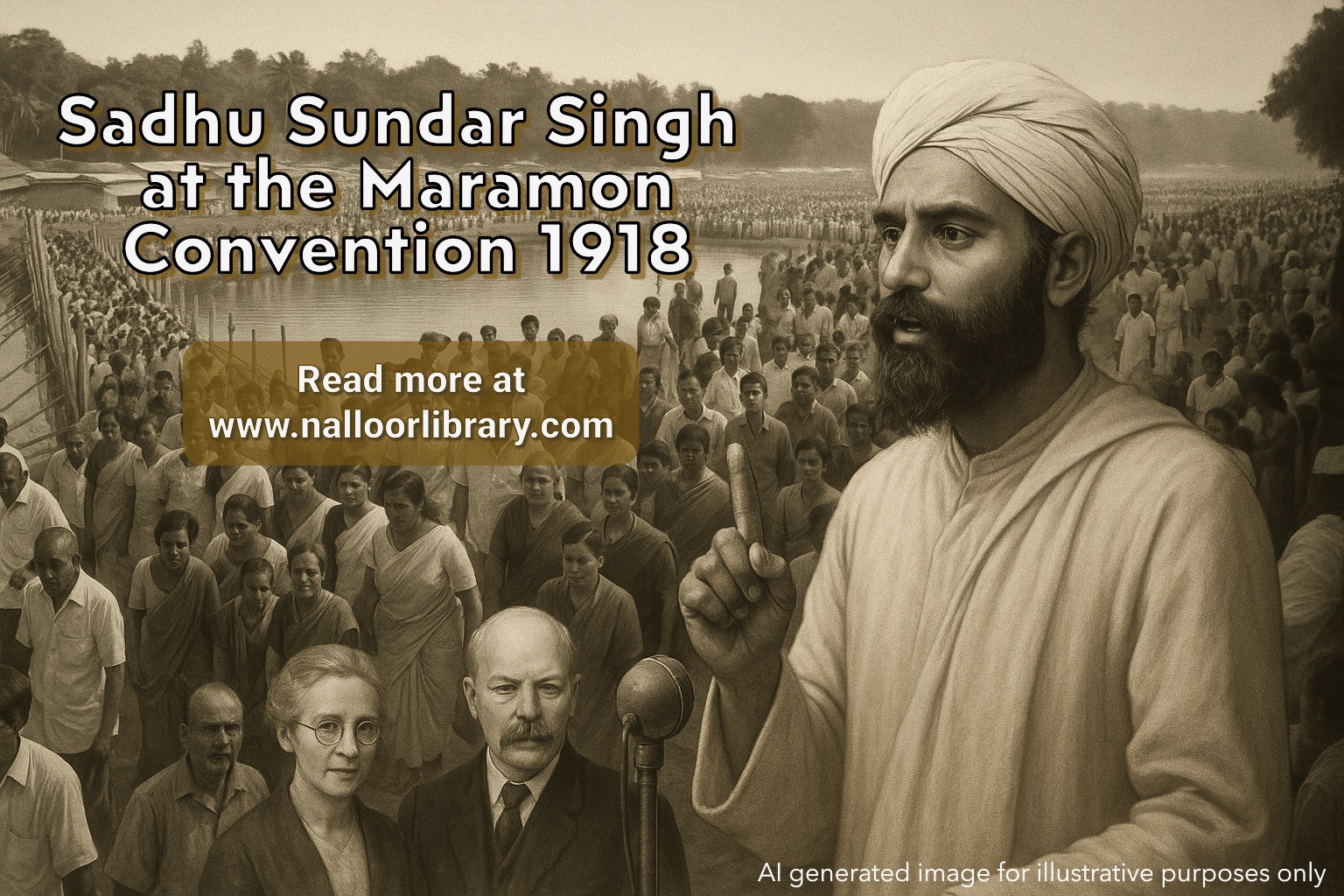
Church historians have always debated when the famed missionary Sadhu Sundar Singh visited the world renowned Maramon Convention. Many church history books mistakenly mention 1917, 1918, or 1919 or all the three years. However, Sadhu Sundar Singh came to the Maramon Convention only once in 1918.
NalloorLibrary.com presents evidence from a chapter from a book – Sadhu Sundar Singh, Called of God (1920) authored by Mrs. Rebecca Arthur Parker. It is a first hand eye-witness account of the 1918 convention through the eyes of Mrs. Rebecca Arthur Parker. She mentions in the detail the convention grounds, the number of people, the sights she saw and how 32,000 people gathered to hear Sadhu Sundar Singh at a venue built for 25000 people.
Mrs. Rebecca Parker also mentions the two Bishops of the Mar Thoma Syrian Church, who appeared daily in resplendent robes of red or purple satin with gold belts and quaint head-dresses. In 1918, the Mar Thoma Syrian Church had only two Bishops – His Grace the Most Rev. Titus II Mar Thoma Metropolitan and Suffragan Metropolitan Bishop Abraham Mar Thoma. Both bishops served tirelessly for the building up of the church.
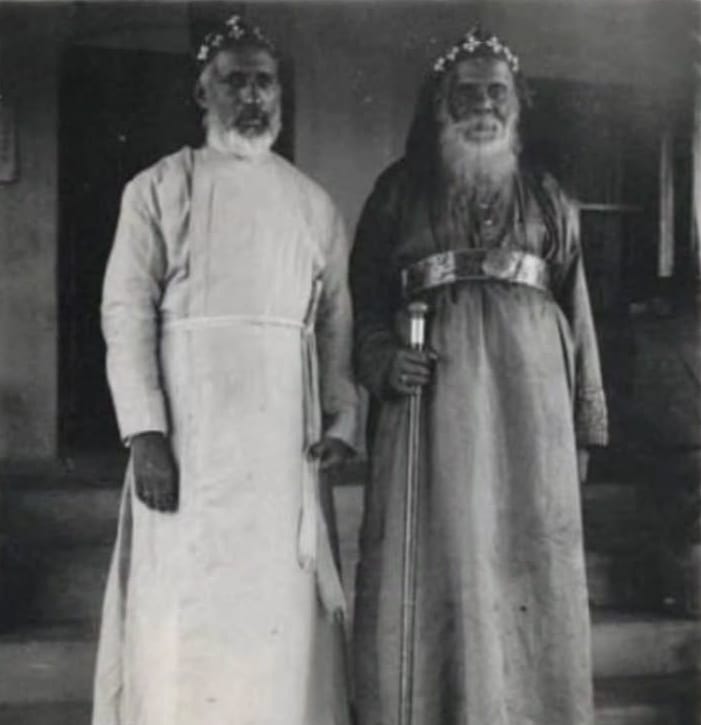
His Grace the Most Rev. Titus II Mar Thoma Metropolitan
He was the nephew of Titus I Metropolitan and was consecrated by him at Puthencavu St. Mary’s Church in 1898, assisted by Metropolitan Mar Koorilos of Thozhiyoor. He worked with Titus I as his Suffragan Metropolitan, and became Metropolitan in 1910. He worked vigorously for the building up of the Church.In those days when it was difficult to travel, he visited Churches in out-of-the-way locations and organized the Parishes on organizational lines. He took measures to ensure that the Parish officials maintained the Parish account up-to-date;and he fostered various programmes of the Parishes. The Mar Thoma Sevika Sangam was organized in 1919 and the Voluntary Evangelists Association in 1925. The Mar Thoma Theological Seminary for the training of the Clergy was established at Kottayam in 1926. Bishop Abraham Mar Thoma was consecrated as Suffragan Metropolitan in 1917 and the two Bishops worked together tirelessly for the growth of the Church. Titus II Mar Thoma passed away in 1943 after being Metropolitan for 33 years.
His Grace the Most Rev. Dr. Abraham Mar Thoma Metropolitan
Abraham Mar Thoma was known all over India for his burning passion for evangelism, for his zeal for spreading the Gospel through the length and breadth of India. He received theological training in India and Canada. It was during this time that the Mar Thoma Church became well known in the Western World. He was consecrated Bishop in the year 1917 and he worked relentlessly as Suffragan Metropolitan for the spiritual strengthening of the Church and for its witness. He was installed Metropolitan in 1944 when Titus II Metropolitan passed away. He was born in an illustrious Orthodox family but his father passed away when he was very young and he was brought up in his mother’s house at Eraviperoor, a home which cherished the blessings of the reformation.He was President of the Mar Thoma Evangelistic Association and the National Missionary Society. Even though he was suffering from acute diabetes for many years, he went on working with the motto: “it is far better to burn out than to rust out”. The Abraham Mar Thoma Bible Institute established for the training of voluntary evangelists in the Church was named after him. Though he was Metropolitan only for four years, his long ministry as Bishop strengthened the Church in all its missionary enterprises. He was called to eternal home in 1947.
Who were the Parkers?
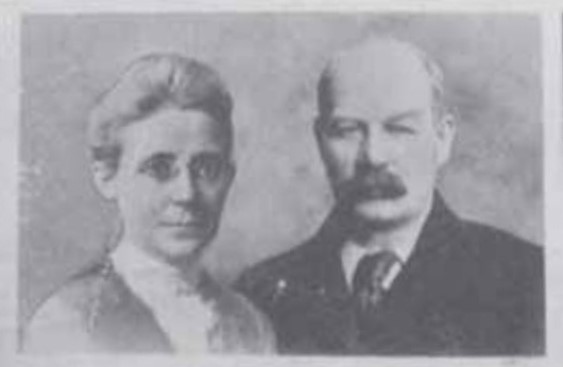
Rebecca Jane Parker: born, 1865; a church member in Bromsgrove, Worcestershire; married Arthur Parker (1858-1935, a London Missionary Society (LMS) missionary in South India). Working with her husband in the Trivandrum area, she ran a hostel and boarding home for Christian girls and Bible women; established an embroidery industry, employing over 1,000 Christian women.
Singh and Rebecca Parker began a correspondence from March 1918. In his letters, Singh addressed Parker as ‘my dearest Mother’ and signed off as ‘Sundar’, often as ‘your ever loving son’, and referred to Reverend Parker as ‘Father’. Parker, born in 1865, is described as adoptive mother to Singh in the LMS Archives, and she was certainly an older, benevolent figure who looked after Singh, who had no mother of his own. Singh came to fame outside of South Asia largely through the efforts of Rebecca Jane
Parker, wife of Arthur Parker, members of the London Missionary Society (LMS) in
Trivandrum, South India. ~ S. Mukherjee
Mrs. Parker was awarded the Kaisar-i-Hind medal by the British government for social service in 1921. She retired in 1925 and died at Leamington Spa, England, in 1946.
Rev. Arthur Parker took charge in 1900 as the fourth LMS missionary in Trivandrum. The construction of a new church building (Mateer Memorial Church) in the LMS Compound was undertaken in four years (1902-1906). It was dedicated on December 1, 1906 by Rev. R. W. Thompson, the Foreign Secretary of the LMS who was heading a deputation as part of the centenary of the Travancore Mission (estd. in 1806 by Ringeltaube at Mylaudy). He died on 6th December 1935.
https://www.mateermemorialchurch.com/
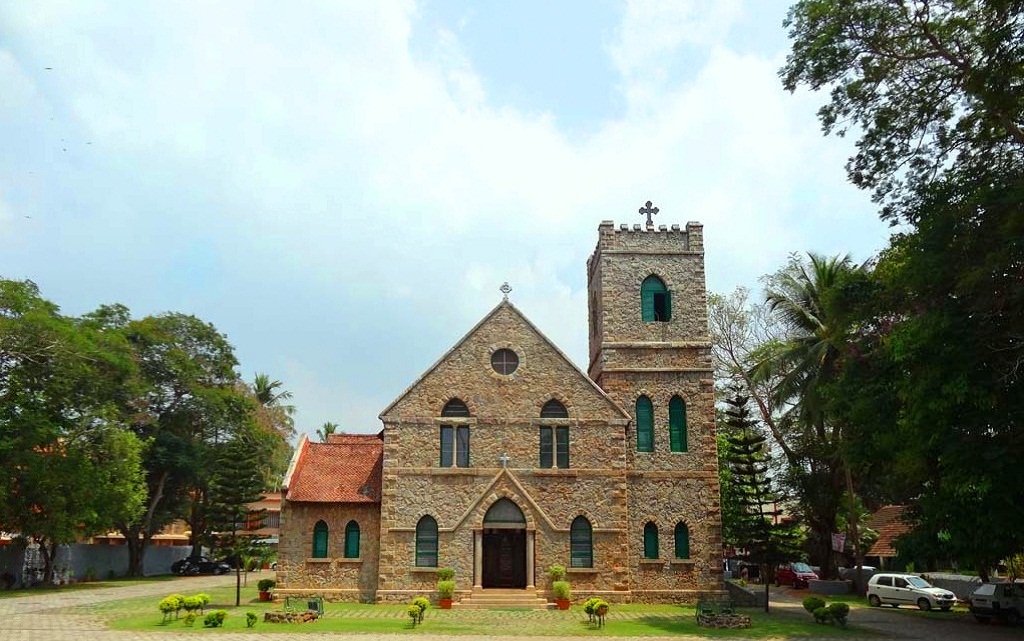
CSI Mateer Memorial Church: A Pillar of Protestant History in Trivandrum
Located in the heart of Palayam, the CSI Mateer Memorial Church is a cornerstone of Protestant Christian heritage in Kerala. Originally founded in 1838 by the London Missionary Society (LMS), it began as a simple chapel established through the efforts of early missionaries like Rev. John Cox and local supporters.
The early congregation grew steadily under Rev. Cox, who formalized the church’s structure through a trust deed open to all Protestant Christians. Over time, it also hosted Malayalam and Tamil services, serving both the local Christian community and visiting British officials. In 1893, following the death of Rev. Samuel Mateer-an influential missionary who significantly contributed to its growth-a plan was initiated to construct a larger building in his memory. By 1906, a new church building was completed at the LMS Compound under the guidance of Rev. Arthur Parker and dedicated by Rev. R.W. Thompson.
Architecturally, the church is distinguished by its Hallenkirche-style layout, Gothic arches, granite construction, and iconic square bell tower. It was not merely a change of building but a continuation of the same community, making it a rare example of living ecclesiastical heritage. Through centuries of transitions, it remains a vital spiritual space that has shaped the religious and educational landscape of Trivandrum, closely linked with institutions like University College and the city’s early missionary schools.
~Source: https://www.keralatourism.org/destination/lms-church/603/



 Nalloor Library