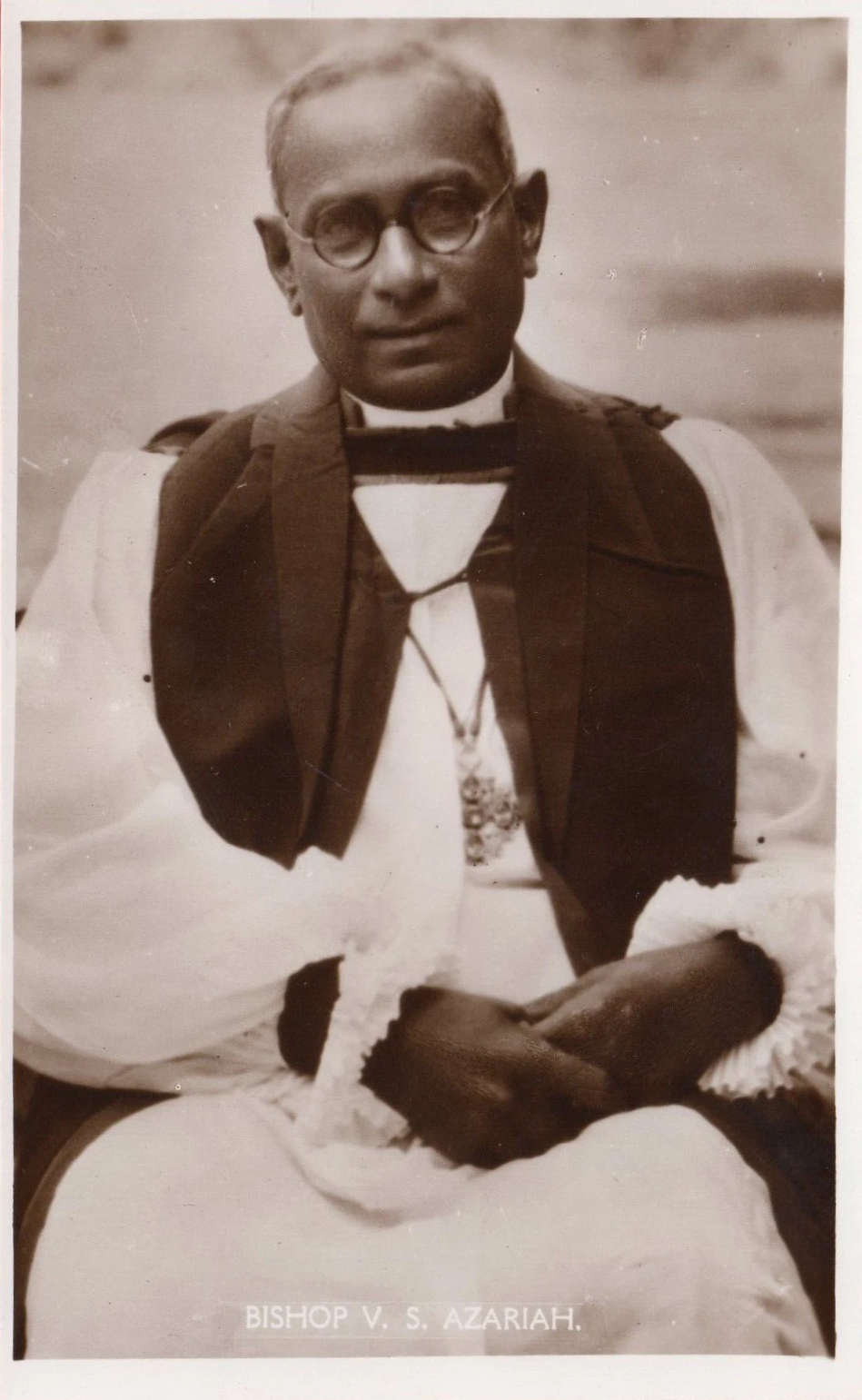
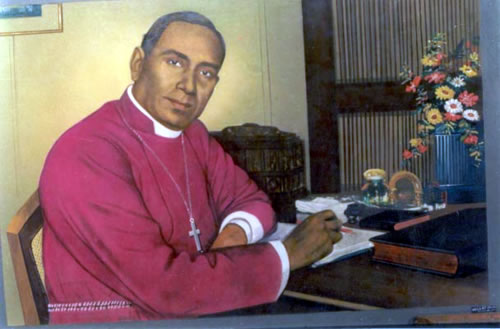
12 December, 1912: Consecration of Bishop V. S. Azariah.
Rev. Vedanayagam Samuel Azariah was consecrated as the first Indian Bishop of the Church in India (Anglican Church) on 12 Dec 1912, in the St. Paul’s Cathedral in Calcutta. Most Rev. Dr. Copleston, assisted by ten other bishops, conducted the consecration ceremony.
First Indian bishop of the Anglican Church in India
The first Indian bishop of the Anglican Church in India, Vedanayagam Samuel Azariah was born in 1874 in a small village in Andhra Pradesh, the son of Thomas Vedanayagam, an Anglican priest, and Ellen, a woman with a deep love and understanding of the Holy Scriptures. Samuel became a YMCA evangelist at nineteen and secretary of the organization throughout South India only a few years later. He saw that, for the Church in India to grow and to bring ordinary Indians to Jesus Christ, it had to have indigenous leadership.
He helped to create the Tinnevelly-based Indian Missionary Society in 1903, and was a co-founder of the National Missionary Society of India, an all-India, Indian-led agency founded in December 1905.
At the age of thirty-five he was ordained to the presbyterate, and three years later (December, 1912) he was consecrated as the first bishop of the new Diocese of Dornakal, with eleven bishops of the Anglican Church in India participating in the liturgy at St Paul’s Cathedral in Calcutta. Bishop Azariah was the first Indian to be consecrated a bishop in the Churches of the Anglican Communion. Bishop Azariah died on January 1, 1945, two years before the inauguration of the united Church of South India (CSI).
The Bishop and the Blessing: A Story from the Life of Vedanayagam Samuel Azariah:
Bishop Vedanayagam Samuel Azariah, accompanied by the Archbishop of Canterbury Robert Runcie, visited a small village in his diocese. As they approached, an elderly woman emerged from her humble dwelling. She had never seen a white Archbishop before, and was struck by the sight of this important figure arriving in a grand car with a police escort.
To everyone’s surprise, Archbishop Runcie bowed before the elderly villager. Without hesitation, the woman placed her hands on his head and offered a blessing. Moved by this unexpected act of faith, the Archbishop was overcome with emotion . “Nobody has ever done this to me,” Runcie said, tears in his eyes. “I have laid my hands on many people. But this mother has laid her hands on me.”
This simple yet profound moment exemplified Bishop Azariah’s lifelong mission – to cultivate an indigenous Indian church where the faith of ordinary people could flourish. It revealed the deep spirituality he nurtured among his flock, where even the humblest villager felt empowered to bless an Archbishop. The incident also highlighted Azariah’s ability to bridge cultures, bringing together a high-ranking English cleric and a poor Indian woman in a touching display of mutual respect and shared faith.
Azariah had two great priorities in his work: evangelism and the desire for Christian unity.
He understood evangelism to be the acid test of Christianity. When asked what he would preach about in a village that had never heard of Christ, Azariah answered without hesitation: ‘The resurrection.’ From a convert he demanded full acceptance of Christianity which would include baptism and which could therefore include separation from family and caste. He claimed that Christianity took its origin in the death and resurrection of Jesus Christ and the outburst of supernatural power that this society manifested in the world.
Azariah recognised that because four-fifths of Indian people live in villages, for the Church to be an indigenous one it must be a rural Church. He was constantly in the villages, inspiring and guiding the teachers, clergy and congregations. He blamed the missionaries for not training people in evangelism, and thought their teaching had been mission centred instead of Church centred, and he pleaded with missionaries to build up the Indian Church. Much of the Christian outreach in his area was among the outcast people. Gradually as Christianity spread amongst the villages, the social situation began to change, the Christian outcasts gaining a new self-respect as they realised their worth in the eyes of God.
Azariah considered that one of the factors that hampered evangelism, and possibly the deepening of the spiritual life of the convert, was the western appearance of the Church in both its buildings and its services. As early as 1912 he had visions of a cathedral for the diocese to be built in the eastern style, where all Christians could feel spiritually at home regardless of their religious background and race. Building was delayed because of the Great War in Europe, but finally his dream was realised when the Cathedral Church of The Most Glorious Epiphanywas consecrated on January 6, 1936. The building is a beautiful structure embodying ideas from Christian, Hindu and Moslem architecture. Its dignity and spaciousness create a very different effect from that of the nineteenth and twentieth century Gothic churches and furnishings scattered elsewhere in India.
If evangelisation of India was Azariah’s first priority, the second was that of Church unity. He was the two as interrelated. He believed that a united Church was in accordance with the will of God, ‘that we may all be one’, and he also believed that a United Church would be more effective for evangelism. Addressing the Lambeth Conference in 1930 he pleaded:
“In India we wonder if you have sufficiently contemplated the grievous sin of perpetuating your divisions and denominational bitterness in these your daughter churches. We want you to take us seriously when we say that the problem of union is one of life and death. Do not, we plead with you, do not give us your aid to keep us separate, but lead us to union so that you and we may go forward together and fulfil the prayer, ‘That we may all be one.’”
Bishop Samuel is commemorated in the sanctoral calendars of the Anglican Church in North America and the Church of England on January 2.
The guest house of the National Council of Churches in India at their Nagpur headquarters is known as Azariah House in memory of the Bishop.





 Nalloor Library